Tuition & scholarships, and the steps from enrollment to arrival in Korea
1. General Information on Tuition & Scholarships
1-(1)Tuition & Scholarships at a Glance

▪Tuition ranges from 3–5 million KRW at public colleges and 6–9 million KRW at private colleges
Tuition at junior colleges varies greatly depending on the type of institution and the field of study. National and public colleges generally cost less than private ones, and even within the same school, health, arts, sports, and science-and-engineering programs tend to charge higher tuition than humanities or social science programs. There are three main ways to ease the financial burden: the Korean Government Scholarship (GKS), school-funded scholarships, and local government scholarships. GKS offers broad support that can cover both tuition and living costs, but it cannot be combined with other scholarships. School and local government scholarships, on the other hand, can usually be received together, so it is wise to research the various programs in advance and combine the ones that fit your situation.
-
Korean Government Scholarship (GKS)
Full coverage of tuition & living expenses; acceptance rate approx. 5–13%
-
School-Funded International Student Scholarships
5 types: academic excellence, nationality-based, freshman, current student, and major-specific
-
Local Government Scholarships
300,000–1,000,000 KRW per semester from non-metropolitan local governments; can be combined with school scholarships
- Public junior colleges: approx. 3–5 million KRW
- Private junior colleges: approx. 6–9 million KRW
- Arts, physical education, and health-related programs are more expensive than general programs
Study in Korea — Korean Government Scholarship (GKS) Information
1-(2)Scholarship Types & How to Apply
Korean Government Scholarship (GKS) Details
- Eligibility: Foreign nationals who have graduated (or will graduate) from high school in their home country; generally under 25 years old (approx. 280 students selected from 71 countries as of 2026).
- Benefits: 1 year of Korean language training + full tuition for the degree program + monthly living allowance of 900,000 KRW + round-trip airfare + settlement allowance + National Health Insurance.
- Application Period: Apply around September each year through the Korean Embassy in your home country (Embassy Track) or a Korean university (University Track).
- Application Method: From 2026, online applications via the Study in Korea portal are mandatory. Embassy Track: 150 spots; University Track: 130 spots (including junior colleges and UIC).
- Acceptance Rate: Overall average approx. 5–13%. The junior college (Associate Degree) track in particular has very few spots, making competition extremely high.
Types of School-Funded International Student Scholarships
Most junior colleges run their own scholarships to attract international freshmen. While names vary by school, they generally fall into the following 5 categories.
| Type | Eligible Students | Coverage (Examples) | Notes |
|---|---|---|---|
| Academic Excellence Scholarship | TOPIK Level 4–6 holders or top-ranking high school students | 30–100% tuition reduction | Many require maintaining a minimum GPA while enrolled |
| Nationality-Based Scholarship | Priority for certain countries (Vietnam, Uzbekistan, Mongolia, China, Southeast Asia) | 20–50% tuition reduction | Limited quota per country; early deadline |
| Freshman Scholarship | All incoming international students | 30–50% tuition reduction for the 1st semester | Often not automatically renewed from the 2nd semester onward |
| Continuing Student Scholarship | 2nd year and above with a GPA of 3.0 or higher in the previous semester | 20–80% tuition reduction | Must apply each semester; immediately suspended if GPA falls short |
| Major / Certification Scholarship | Students in specific programs (healthcare, mechanical engineering, aviation) or those who earned a qualification | 10–50% tuition reduction + exam fee support | Applies to the specific major only; reclaimed if certification is not obtained |
Local Government Scholarships
Non-metropolitan local governments pursuing population growth and foreign resident attraction policies (certain cities and counties in South Jeolla, North Gyeongsang, Gangwon, and South Chungcheong provinces) fund scholarships for international students out of their own budgets. The biggest advantage is that these can be combined with school scholarships.
- General Requirements: Enrolled at a junior college in the relevant region + maintaining alien registration (foreigner registration) in that region.
- Benefits: 300,000–1,000,000 KRW per semester as a living allowance or partial tuition subsidy.
- Employment-Linked Type: Additional scholarships are paid to students who commit to working at a company in the same region for a set period (usually 2 or more years) after graduation.
- How to Apply: Announcements are posted on city/provincial government websites for about 1 month before and after the semester starts. The school's international affairs office often provides guidance as well.
Scholarship Application Process — 5 Steps
Check Scholarship Types & Eligibility
First, check the school's website under "International Student Scholarships" and compare GKS with school-funded scholarships. School scholarships are often listed together within the admissions guidelines.
1–2 months before applyingPrepare Required Documents
Transcripts, TOPIK score, and a personal statement are the basics; proof of family finances, a separate scholarship personal statement, and a recommendation letter may also be required.
1 month before applyingSubmit Application
GKS applications go through the Study in Korea online system; school scholarships are generally submitted together with the school admission application. Local government scholarships require a separate application on the city/provincial government website.
Before/after semester startReview & Interview
GKS has 3 stages: 1st document review, 2nd embassy interview in the home country, 3rd Korean university evaluation. For school scholarships, freshman scholarships are reviewed automatically; continuing student scholarships may include an additional interview.
1–3 monthsResults & Award
After acceptance, the school's student support office deducts from tuition or deposits directly to your account. Scholarships that require renewal each semester are automatically re-reviewed immediately after the previous semester's grades are released.
1–2 weeks after results1-(3)Tuition Payment Methods
- Lump Sum Payment: Transfer the full semester amount by the enrollment deadline. The most common method; used by most students when tuition is in the 2–4 million KRW range.
- Installment Payment (2–4 installments): Available at schools where tuition exceeds 3 million KRW. Payments can be split in 1–2 month intervals after the semester starts, but installment payment must be applied for separately before the semester begins.
- International Wire Transfer: Bank fees of 20–50 USD apply when sending from Vietnam, Uzbekistan, Mongolia, or China. Once the school issues a virtual account number, make sure to include your student ID and name in the transfer memo.
- Refund Policy: Under Korea's "Regulations on University Tuition," the standard is: ① 100% refund before classes begin, ② 5/6 refund up to 1/6 of the way through, ③ 2/3 refund at 1/3 through, ④ 1/2 refund at 1/2 through, ⑤ no refund after 1/2. If entry into Korea is impossible due to visa rejection, a separate appeal process exists.
1-(4)Traits of Scholarship Recipients
- Academic Record: Top 20–30% or higher in high school grades in their home country, or graduates of prestigious schools. Many schools value a "trend of improving grades year over year" more than raw scores.
- Language Skills: TOPIK Level 4 or above automatically qualifies for most school scholarships. For GKS, reaching TOPIK Level 3 before entering the main program after language training is typically mandatory.
- Application Effort: Students who apply for all three — GKS, school scholarships, and local government scholarships — end up receiving at least one. Those who don't even try are the ones who miss out the most.
- Personal Statement Quality: Students who had their Korean personal statement reviewed at least once by a Korean mentor (a Korean student tutor at school, a Korean language teacher back home, etc.) before submitting show noticeably higher acceptance rates.
1-(5)Frequently asked questions
2. Post-Acceptance Enrollment Steps
2-(1)Enrollment Process at a Glance
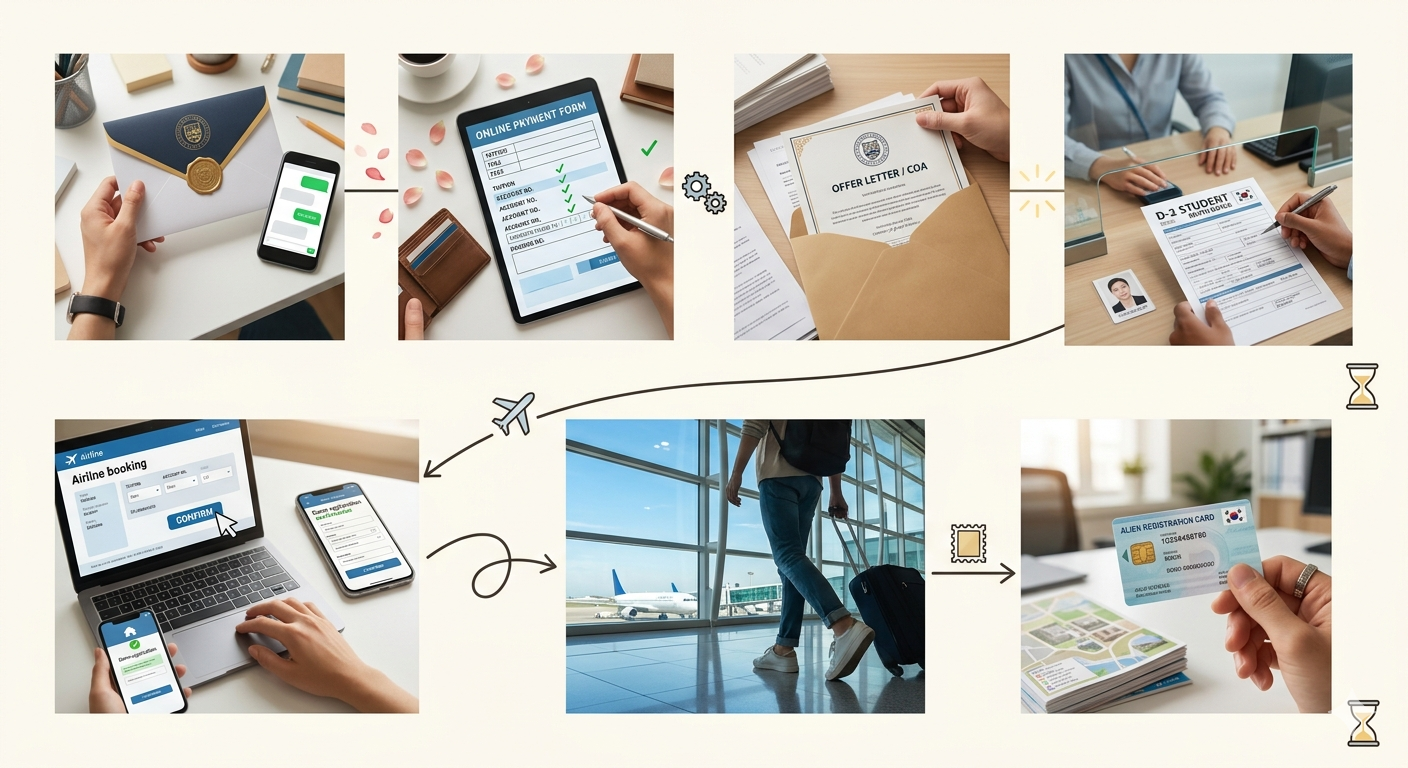
▪An average of 2–3 months from acceptance to arrival — missing the order means missing the semester
Receiving your acceptance notice is not the finish line. Every step — tuition payment → receiving the Certificate of Admission → D-2 visa application → confirming your flight and dormitory → arrival in Korea → alien registration — is interlocked like gears and must be completed in order. Because each stage can only begin once the previous one is done, falling behind on even a single step can set off a chain reaction of delays and prevent you from arriving in time for the start of the semester. The journey from acceptance to arrival takes about 2–3 months on average, so checking the required documents and processing times for each stage in advance and managing your timeline with some buffer is more important than anything.
2-(2)From Acceptance to Semester Start — Full Timeline
Check Acceptance Notification
Acceptance notification via the school website or email. Immediately check the enrollment reply deadline and tuition payment deadline.
Reply to Confirm Enrollment + Pay Tuition
Pay tuition to the designated account (usually within 1–2 weeks of acceptance). After payment, reply to the school confirming "enrollment complete."
Receive Certificate of Admission
After confirming tuition payment, the school issues and sends the certificate by mail or email. Average issuance time: 5–7 business days; valid for 3 months.
Apply for D-2 Visa (Home Country)
Apply for the visa at the Korean embassy or consulate in your home country. Submit the Certificate of Admission, proof of finances, proof of academic qualifications, etc.
Visa Issued (3–4 weeks)
Receive passport with D-2 visa affixed. Processing time varies by embassy/consulate.
Book Flight + Confirm Dormitory
After visa is issued, book the arrival flight, check dormitory application results (or sign a lease near the school).
Arrive in Korea
Recommended to arrive 1–2 weeks before the start of school. Bring the Certificate of Admission and proof of finances to immigration at the airport.
School Registration + Orientation
After arriving at school: complete enrollment, move into dormitory, attend orientation, and apply for alien registration.
What to Do Within 1 Week of Acceptance
- School-designated form or email
- Missing the deadline results in cancellation of acceptance
- Decide immediately if accepted by multiple schools at the same time
- Use school-designated account; strictly observe the deadline
- Include your application number and name in the sender name exactly
- Keep the payment receipt
- Documents required after acceptance (e.g., vaccination records)
- Fill out the dormitory application form
- Check the guidance email from the international affairs office carefully
Tuition Payment Methods
- International wire transfer from your home country bank to the school account
- Processing time: 2–5 business days
- Wire transfer fee: usually 30–50 USD
- "Sender name = application number + name" must be entered in English
- Online transfer services may be cheaper than major banks (check availability by country)
- Sending tuition and initial living expenses together in one transfer saves on fees
- Keep the transfer receipt and exchange rate confirmation (needed for alien registration and visa renewal)
- Transfer at least 1 week before the enrollment deadline (to account for transfer delays)
2-(3)Preparing Your Dormitory & Flight
Dormitory Application Schedule
Apply for dormitory immediately after acceptance
Most schools operate on a first-come, first-served basis. Recommended to apply within 1–2 weeks of acceptance notification.
Submit health certificate and vaccination records
Prepare documents required by the school, such as tuberculosis and infectious disease test results.
Pay Dormitory Fee
Transfer within the designated deadline after acceptance notification. In many cases, a separate account from tuition.
Check Room Assignment
Notification of room number and roommate information (usually 2–4 weeks before arrival).
Move In — Day of Arrival at School
Make sure the planned move-in date matches the flight arrival date.
International vs. General Dormitory
| Category | International-Only Dormitory | General (Mixed with Korean Students) Dormitory |
|---|---|---|
| Operating Schools | Schools with a large international student population | Most junior colleges |
| Advantages | Direct management by the international affairs office; multicultural friendships | Everyday interaction with Korean students accelerates Korean language improvement |
| Disadvantages | Fewer opportunities to use Korean; easy to socialize only with students from your own country | Need to adapt to cultural differences and dorm rules |
| Cost | Approx. 1–2 million KRW per semester (additional cost if meals included) | Approx. 800,000–1,800,000 KRW per semester (meals separate) |
| Recommended For | First semester in Korea; beginner Korean level | From the 2nd semester onward; intermediate Korean or above |
Flight Booking Guide
- Book immediately after visa is confirmed (prioritize refundable tickets)
- Late February–early March and late August–early September are peak season — book 1–2 months in advance
- If possible, arrive 1–2 weeks before the semester starts
- One-way tickets are not recommended for entry — some embassies require a round-trip or return flight booking during visa screening to confirm your intention to return home
- If you have no plans to visit home after the semester ends, choose a "changeable round-trip" ticket
- One-way tickets are cheaper but may result in additional questions at immigration
- Direct: faster and safer, lower risk of lost luggage — more expensive
- Connecting: cheaper — must verify layover time and visa requirements for the transit country
- For international students with 20–30 kg of luggage, purchasing additional baggage options in advance is cheaper
- For medicine and home-country food ingredients, only bring what is hard to find in Korea
- Check voltage compatibility (220V) — bring adapter in advance
- Keep original academic and financial documents in your carry-on bag separately
- It is more practical to buy winter clothes in Korea than to bring them
2-(4)First Week After Arriving at School
Airport → Arrive at School / Move into Dormitory
Use the school shuttle bus or airport rail/KTX. Complete dormitory check-in (contract, ID, and passport photo required).
Report to International Affairs Office
Notify the international affairs office of your arrival and receive guidance. Apply for student ID, meal card, and library card.
Prepare Alien Registration Application
Prepare passport, photo, enrollment certificate, and proof of address (dormitory move-in confirmation). Application must be filed within 90 days of entry.
Get a Mobile Phone
Sign up for a Korean SIM card or budget phone plan. Some carriers restrict services without an alien registration card — you can start with a prepaid SIM.
Open a Bank Account
Temporary foreign account can be opened with passport + student ID. Convert to a regular account after receiving the alien registration card.
Complete Enrollment & Attend Orientation
Finish school enrollment administrative procedures; mandatory attendance at the international freshman orientation.
Check Classes & Course Registration
Meet with academic advisor, finalize course registration, buy textbooks, and learn the campus layout.
5 Things Most Easily Missed After Acceptance
- Missed enrollment reply — Paying tuition without officially replying to the school with your "enrollment intention" can result in cancellation of acceptance. Confirm via email or phone.
- Late dormitory application — Many schools have first-come, first-served deadlines; waiting more than a week after acceptance means no spots left. Rushing to find off-campus housing is expensive and risky.
- Unprepared vaccinations — Some schools require proof of vaccination (measles, tuberculosis, hepatitis B, etc.) before entry. Handling this in your home country saves time.
- Visa processing delays — You must apply for your visa as soon as you receive the Certificate of Admission to be in time for the semester. Spending a month doing nothing between "acceptance → visa application" will delay your arrival.
- Late flight booking — During peak seasons in late February and late August, direct flights sell out 1–2 weeks in advance. Prices can rise 2–3 times and only connecting flights remain.