D-2 student visa, D-4 training visa, D-10 job-seeking visa — visas for students
1. D-2 study visa
1-(1)D-2 study visa at a glance

▪The standard visa for students enrolled in a Korean degree program
This is the most common student visa, issued to foreigners enrolled in a regular degree program at a junior college, university, or graduate school. For anyone preparing to study in Korea, it is typically the very first visa they encounter. Because attendance and grades are continuously managed on a semester basis, keeping the visa is not just about entering the country—it depends on diligently keeping up with your studies. In addition, after entry you must complete alien registration within 90 days; missing this step can create disadvantages for your later stay and for various administrative procedures, so it is especially important to stay on top of the schedule.
1-(2)Process from D-2 visa issuance to alien registration
School admission
Standard Letter of Admission issued (valid for 3 months)
Visa application
Apply for and have D-2 visa reviewed at the Korean embassy/consulate in your home country
Entry
Arrive at Incheon Airport and complete school enrollment procedures
Alien registration
Within 90 days of entry, at the competent immigration office
- Eligible: students enrolled in a regular Korean degree program (junior college, university, graduate school)
- Evening colleges, cyber universities, distance universities, and vocational training schools are excluded from D-2 (separate visa such as D-4 applies)
- Length of stay: granted in line with the study period, managed on a semester-by-semester renewal basis
- Alien registration at the competent immigration office is mandatory within 90 days of entry
| Classification | Eligible | Main cases |
|---|---|---|
| D-2-1 | Associate degree program | Students enrolled in a 2–3 year junior college |
| D-2-2 | Bachelor's degree program | Undergraduate students at a 4-year university |
| D-2-3 | Master's degree program | Master's students at general or professional graduate schools |
| D-2-4 | Doctoral degree program | Doctoral students at general or professional graduate schools |
| D-2-5 | Research program | Research activities at a university-affiliated research institution |
| D-2-6 | Exchange student | Exchange students under inter-university exchange agreements |
| D-2-7 | Work-study abroad | Degree + industry-linked program |
| D-2-8 | Short-term study abroad | Short-term programs of less than one semester, etc. |
1-(3)Required documents and eligibility
- Visa application form · passport-size photo
- Passport copy (valid for at least 6 months)
- Standard Letter of Admission (issued by the school, valid for 3 months from the date of issue)
- Final academic certificate (with apostille or consular authentication)
- Bank balance certificate (equivalent to USD 20,000 or more, recommended to have been maintained for at least 6 months)
- Family relationship certificate (if financial guarantor is a parent)
- Medical certificate (required for certain nationalities)
- Have you been admitted to a regular Korean educational institution (junior college, university, or graduate school)?
- Can you obtain an apostille or consular authentication for your final academic documents?
- Can you prove sufficient financial means equivalent to one year of tuition plus living expenses?
- Do you meet the TOPIK level required by your school (usually level 2–3 or above) or the English-track qualification?
- Can you secure an alien registration appointment within 90 days of entry?
| Who this visa is suitable for | Who this visa is not suitable for |
|---|---|
| Students formally admitted to a degree program at a Korean junior college or university | Those enrolling in evening colleges, cyber universities, distance universities, or vocational training schools |
| Students who can prove financial means (equivalent to USD 20,000) | Those who only want to learn Korean without any intention of enrolling in a degree program (D-4 is more appropriate) |
| Students who can consistently maintain per-semester attendance and grade requirements | Cases where low attendance or grades make it likely that academic warnings will accumulate |
1-(4)Frequently asked questions
2. D-4 general training visa
2-(1)D-4 general training visa at a glance
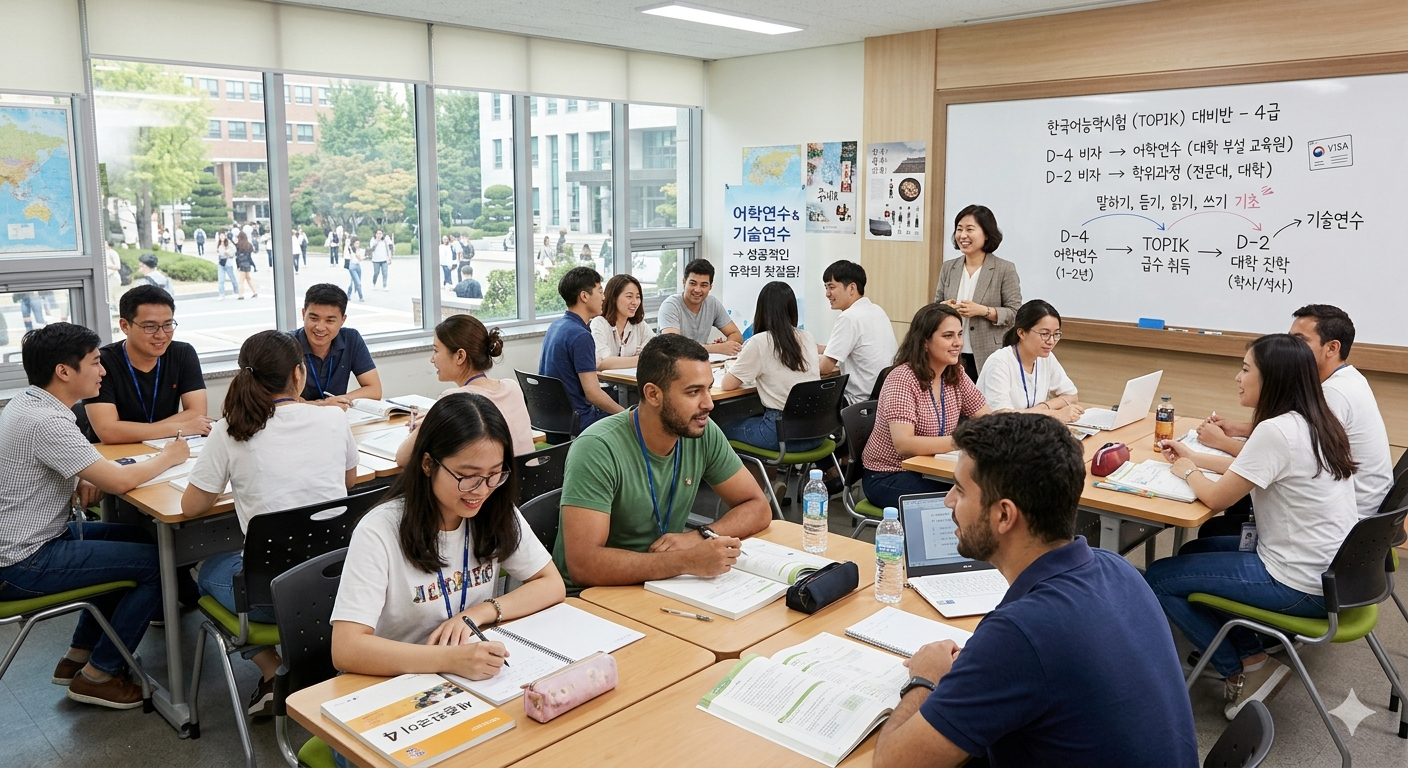
▪A visa for language or vocational training, not a degree program
This visa applies to non-degree programs such as Korean language training (e.g., university-affiliated Korean language institutes) or vocational training that do not lead to a degree. It is often used as a preparatory stage where students whose Korean is not yet strong enough can steadily build their listening, speaking, reading, and writing foundations before entering a junior college or university. One advantage is that this period lets you develop both your Korean ability and your day-to-day adaptation to life in Korea at the same time. Later, once you are admitted to a degree program, you can change to the D-2 student visa and move smoothly into your formal studies.
2-(2)D-2 degree program vs D-4 general training
D-2 (degree program)
- Regular degree programs at junior colleges, universities, and graduate schools
- Single stay period up to 2 years
- Bank balance of USD 20,000 equivalent recommended
- Part-time work permit application available
D-4 (general training)
- Non-degree programs such as Korean language training
- Single stay period up to 2 years
- Bank balance of USD 10,000 equivalent is typical
- Mandatory attendance of 80% or more; part-time work is more restricted
- Eligible: non-degree programs such as Korean language training and vocational training
- Main classifications: D-4-1 (university-affiliated language training), D-4-7 (foreign language instructor training, etc.)
- Can be changed to D-2 (upon admission to a degree program)
- Part-time work: partially permitted when certain conditions are met
| Classification | Eligible | Notes |
|---|---|---|
| D-4-1 | University-affiliated language training | Most common; used as a preparatory stage before entering a junior college |
| D-4-2 | Foreign language training (other than Korean) | Foreign language training at middle or high school affiliates, etc. |
| D-4-3 | Study abroad for elementary, middle, and high school students | Regular school study abroad for minors |
| D-4-6 | Private institution training | Private Korean language institutes not affiliated with a university, etc. |
| D-4-7 | Foreign language conversation instructor training | Instructor training programs |
2-(3)Required documents and eligibility
- Visa application form · passport-size photo
- Passport copy
- Letter of admission (from a university-affiliated Korean language institute, etc.)
- Final academic certificate (high school graduate or above)
- Bank balance certificate (equivalent to USD 10,000 or more is typical)
- Tuition payment receipt
- Family relationship certificate · financial guarantee documents
- Can you enroll in an officially authorized institution such as a Korean language institute?
- Can you prove an educational background of high school graduate or above?
- Can you prove sufficient financial means to cover at least 6 months of tuition and living expenses?
- Are you confident you can maintain an attendance rate of 80% or above during the semester?
- Do you have a clear plan to transition to a D-2 degree program or return home afterward?
| Who this visa is suitable for | Who this visa is not suitable for |
|---|---|
| Students whose TOPIK level is insufficient to go directly to D-2 | Students who already meet the TOPIK requirement at the time of admission (going directly to D-2 is more efficient) |
| Students who want to build a Korean language foundation before entering a junior college or university | Those who enter Korea without intent to study and only aim to work or do part-time jobs |
| Students who can stably manage their attendance | Cases where attendance is expected to fall below 80% (both extension and D-2 change will be denied) |
2-(4)Frequently asked questions
3. D-10 job-seeking visa
3-(1)D-10 job-seeking visa at a glance
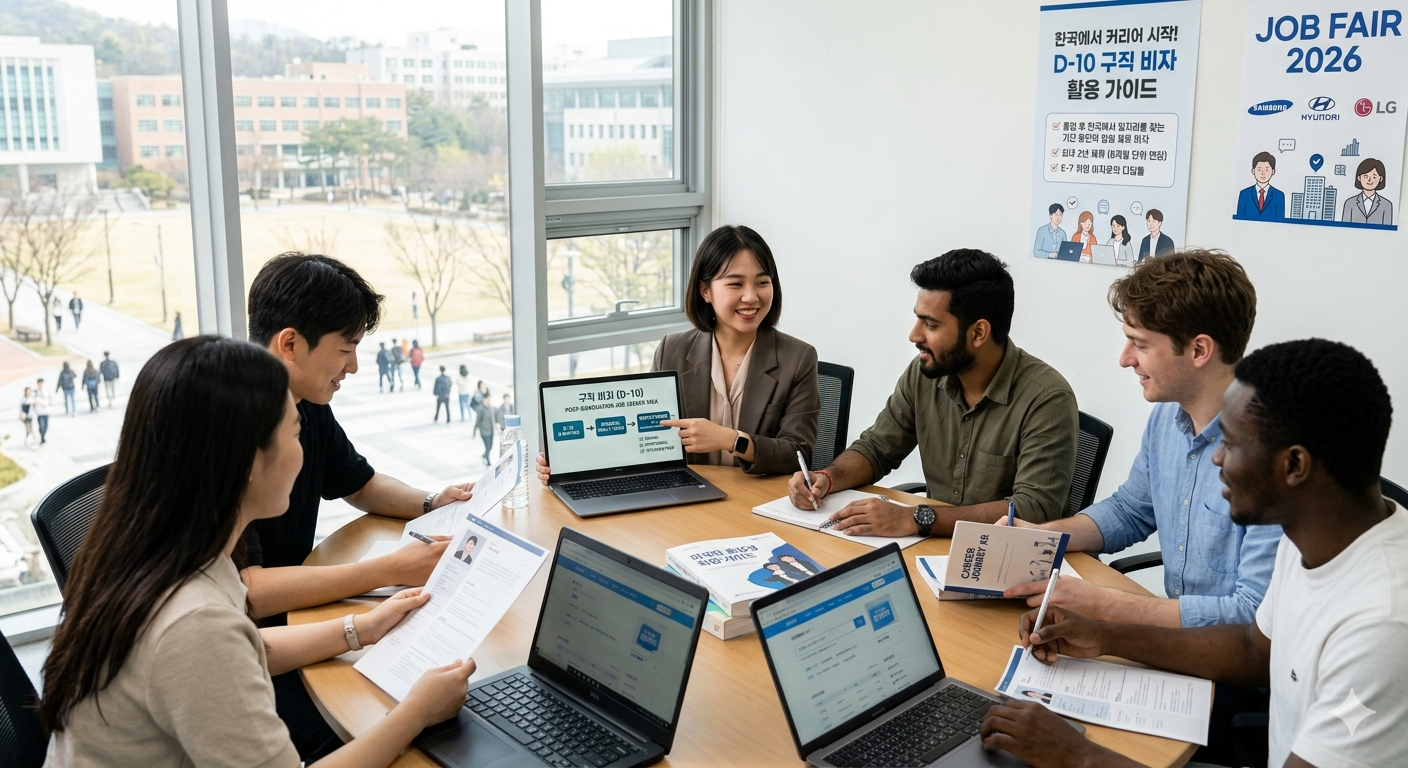
▪A legal residence visa for the period of job searching in Korea after graduation
This visa is granted to graduates who have completed their degree but do not yet have confirmed employment, allowing them to stay in Korea legally while continuing their job search. It is first granted for 6 months and, including extensions, allows a stay of up to a total of 2 years — giving you time to look for work without pressure. During this period you can attend interviews and build experience, and once a job is secured, switching to an employment visa such as E-7 is the most common path. Because you do not have to leave the country the moment you graduate, this visa serves as an important stepping stone for international students who want to begin a real career in Korea.
3-(2)D-10 points-based application process
Degree obtained
Graduated or expected to graduate with a domestic associate degree or above
Self-assessment of points
Check that you have secured a base of 20 points + total of 60 points or more
Document preparation · application
Job-seeking activity plan · points-based evaluation form · Korean language proof
Review · approval
6 months granted, then extendable (up to 2 years total)
- Eligible: legal residence during job-searching in Korea
- Junior college graduates may also apply (exception allowed for holders of a domestic associate degree)
- Recommended to apply within 3 years after obtaining the degree
- Initial 6 months + extension (up to 2 years total)
- Points-based evaluation or proof of Korean language ability such as TOPIK or KIIP (social integration program)
- Total score 190 points maximum; must pass with 20 or more in basic items + total of 60 or more
- Basic items (up to 50 points): age (up to 20 points) · final academic qualification (up to 30 points) — at least 20 points required from these
- Optional and bonus items (remaining points): work experience, domestic study abroad experience, Korean language ability (TOPIK/KIIP), qualifications/certificates, annual income, recommendation from head of central administrative agency, graduation from world-leading universities, global company experience, STEM degree, high-income earners, etc.
- The highest-scoring age group is 30–34; the eligible age range is under 20–50
- Korean language ability is recognized through TOPIK or completion of the Social Integration Program (KIIP)
- Job-seeking activities in occupations corresponding to E-1 through E-7 status
- Employment interviews, company visits, training, and other de facto job preparation activities
- Participation in internships (research and practical) is permitted
- Part-time work alongside job-seeking activities requires a separate activity permit
3-(3)Required documents and eligibility
- Visa application form · passport-size photo · passport copy
- Degree certificate · academic transcript
- Job-seeking activity plan
- Points-based evaluation form (self-completed)
- Proof of Korean language ability (TOPIK score report or KIIP completion certificate)
- Resume · employment certificate (if applicable)
- Bank balance certificate and other documents proving the ability to cover stay costs
- Have you graduated with a domestic associate degree or above? (Expected graduates should apply immediately after graduation)
- Can you secure 20 base points + total of 60 points or more in the points-based evaluation?
- Can you write a concrete job-seeking activity plan? (desired occupation, companies, schedule)
- Do you have sufficient finances to cover 6 months to 2 years of stay costs?
- Do you have a Korean language proof score from TOPIK, KIIP, or similar?
| Who this visa is suitable for | Who this visa is not suitable for |
|---|---|
| Students who need time to job-search after graduation because employment has not been confirmed | Those who already have confirmed E-7 employment (changing directly to E-7 is more efficient) |
| Students who want to build their career through internships and company visits and then move into regular employment | Those who fall short of the 20-point base or 60-point total requirement in the points-based evaluation |
| Graduates who plan to supplement their Korean language level and work experience in a short period | Cases where the sole purpose is to extend stay without a concrete job-seeking activity plan |