Currency, transit, food culture, education — the systems you encounter daily in Korea.
1. Currency and prices
1-(1)Currency at a glance
▪The won (KRW, ₩) — a card/mobile-payment society more than cash
Korea is one of the countries with the highest share of card payments in the world, so you can get by without carrying much cash. From convenience stores, restaurants, and traditional markets to taxis, almost everywhere accepts credit and debit cards, and mobile easy-pay services such as Kakao Pay, Samsung Pay, and Naver Pay are widely used as well. Even small street stalls and snack shops often take cards or easy-pay, so foreigners adapt quickly. That said, to get a card or bank account in your own name in Korea, you first need an alien registration card. For that reason, it is convenient to keep a little cash on hand during your first days after arrival. (See the FAQ below for details on exchanging money.)
| Denomination | Banknote (front · back) | Color | Figure on the front | One-line note |
|---|---|---|---|---|
| ₩1,000 | 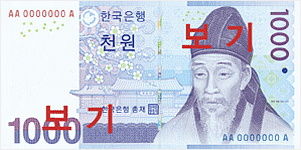 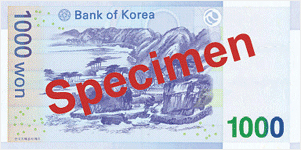 | Blue | Toegye Yi Hwang | Great mid-Joseon scholar; 1,000-won note (most often received as change) |
| ₩5,000 | 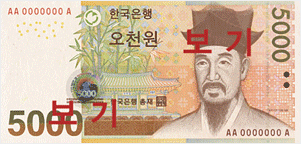 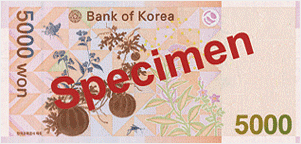 | Reddish brown | Yulgok Yi I | Great mid-Joseon scholar; son of Sin Saimdang |
| ₩10,000 | 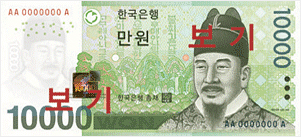 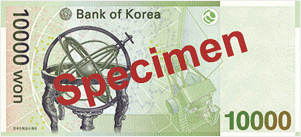 | Light green | King Sejong | The king who created Hangul; the most commonly used note in Korea |
| ₩50,000 | 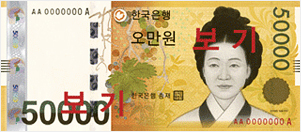 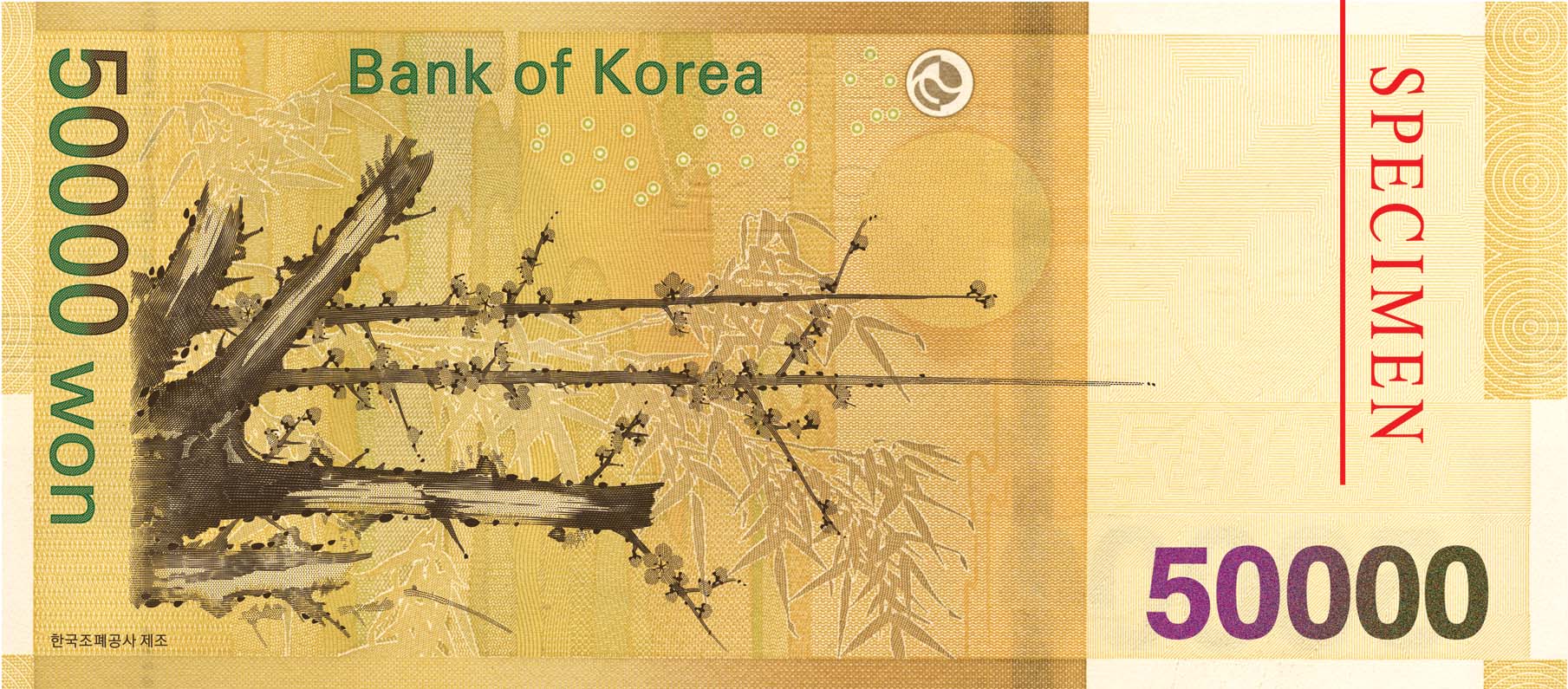 | Yellow | Sin Saimdang | The only woman among current notes; mother of Yulgok Yi I |
| Denomination | Coin (front · back) | Color / material | In daily life |
|---|---|---|---|
| ₩10 |   | Copper-colored, smallest | For making change. Barely used at most shops |
| ₩50 |   | Silver | Occasionally appears as change at convenience stores/vending machines |
| ₩100 |   | Silver | The most usable coin (vending machines, coin laundries, etc.), but increasingly rare as cards and mobile pay take over |
| ₩500 |   | Silver, largest | A large-unit coin for cash transactions. Also used as a cart deposit |
1-won and 5-won coins are issued but almost never seen in daily life. Korea relies heavily on cards and mobile payments, so you rarely handle coins.
1-(2)A cashless society
From convenience stores, restaurants, and markets to taxis, almost everywhere accepts credit/debit cards and mobile payments like Kakao Pay, Samsung Pay, and Naver Pay. Cash-only shops are rare, seen only at some street stalls and traditional markets.
However, to get a Korean credit/debit card, foreigners usually need an alien registration card first (conditions vary by bank). In the early days it's common to carry both your home card and exchanged cash, then open a Korean account and card after registering as a foreigner.
Comparison of 4 payment methods used in Korea
| Payment method | When you can get/use it | Available to foreigners? | Features |
|---|---|---|---|
| Cash | Immediately on arrival (exchange / ATM withdrawal) | Available to everyone | Traditional markets, street stalls, some restaurants. A declining trend |
| Debit card (Korean-issued) | After getting an alien registration card + Korean account | Only those with an alien registration card | The safest everyday payment method. Used within your balance |
| Credit card (Korean-issued) | Requires alien registration + proof of income/employment | Hard for students to obtain | Students usually start with a debit card |
| Mobile pay (Kakao Pay, Naver Pay, Samsung Pay) | After a Korean phone number + registering a Korean card | Possible after alien registration | Pay by holding up your phone via QR/NFC. Usable at almost every shop |
| Foreign-issued VISA/Mastercard | Usable immediately on arrival (offline) | Yes, but limited at some shops/online | May be declined for Korean online shopping and some mobile-pay linkups |
1-(3)Cost of living & housing
| Item | Approx. price | Notes |
|---|---|---|
| 1 school cafeteria meal | 5,000–7,000 won | What international students use most |
| Convenience-store gimbap / triangle gimbap | 2,000–3,500 won | Open 24h, a go-to for late-night meals |
| One ordinary restaurant meal | 8,000–12,000 won | Kimchi stew, gukbap, pork cutlet, etc. |
| Cafe Americano | 2,500–5,000 won | Difference between budget and major brands |
| Vending-machine / convenience-store drink | 1,500–2,000 won | 500mL bottled water about 1,000 won |
| Studio monthly rent | 300,000–700,000 won | Big regional gap (Seoul ↔ provinces) |
| Studio deposit | 1 million won to tens of millions | The biggest upfront burden when living alone |
- Wolse (monthly rent) — the common way of paying rent each month. But in Korea you also deposit a large lump sum ("bojeunggeum"). Example: 5 million won deposit + 400,000 won monthly rent.
- Jeonse — a uniquely Korean system where, instead of paying monthly rent, you hand the landlord a large lump sum (tens of millions to hundreds of millions of won) and live there, getting it back in full when the lease ends. International students rarely live on jeonse.
- The deposit is returned when you move out, but is reduced for any damage or unpaid utilities. Be sure to keep the contract and receipts. Right after moving in, file a residence report (jeonip-singo) at the local community service center and get a fixed date (hwakjeong-ilja) stamped on your contract — this gives your deposit much stronger legal protection.
How much does an international student usually spend in the first month?
| Item | Approx. amount | Description |
|---|---|---|
| Transport/food right after arrival (first week) | ₩100,000 ~ 200,000 | Airport bus, KTX, restaurants, convenience stores, etc. |
| Temporary SIM / phone bill | ₩30,000 ~ 60,000 | Based on a 30-day prepaid SIM |
| Alien registration fee | ₩35,000 | IC-chip card; fee raised in 2025 |
| ID photos, TB screening, etc. | ₩30,000 ~ 70,000 | Public health centers are free or cheap |
| Studio deposit (if living alone) | ₩1,000,000 ~ 5,000,000 | Big gap by region and listing |
| Monthly rent (1 month) | ₩300,000 ~ 700,000 | Around 300,000 in the provinces ↔ 700,000 in Seoul |
| Food (1 month) | ₩300,000 ~ 500,000 | Cafeteria + cooking at home + eating out |
| Transport (1 month) | ₩50,000 ~ 80,000 | Based on commuting by subway/bus |
| National health insurance premium | About ₩79,320 / month | Auto-enrolled on entry with a D-2 visa · pay by the 25th each month (2026) |
| Household goods, bedding, kitchenware, etc. | ₩200,000 ~ 400,000 | One-time move-in spending |
1-(4)Frequently asked questions
2. Transit system
2-(1)Korean transport at a glance
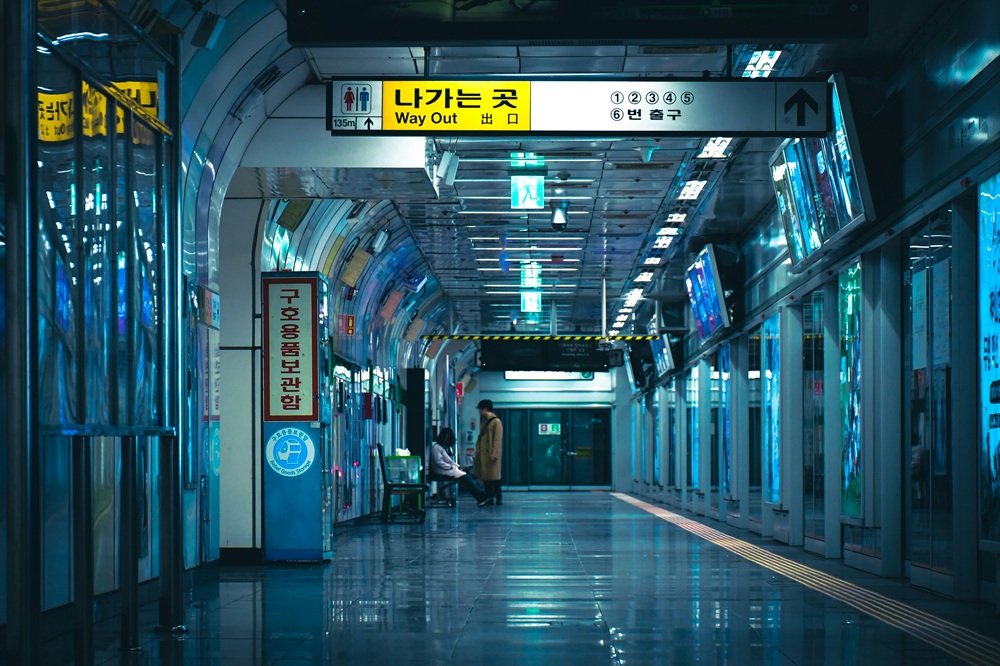
▪Dense public transit that takes you anywhere without a car
Korea has a very dense public-transit network, so you can reach almost anywhere without a car. Subways and buses connect not only the cities but also the areas around campuses, and over 90% of international students get by on the subway and bus alone. Services run frequently and route information is well signposted, so even if you don't know your way you can move around without much trouble. Best of all, paying is simple: with a single T-money card you can cover the subway, bus, and taxi, as well as purchases at convenience stores, all at once. Transfer discounts also apply, so switching from a bus to the subway adds far less to your fare.
2-(2)Getting around the city — subway · bus · taxi
- Operating cities: Seoul, Busan, Daegu, Incheon, Gwangju, Daejeon — 6 cities
- Each line is color-coded, easy for foreigners to remember (e.g., Seoul Line 1 = dark blue, Line 2 = green)
- Station names and announcements are in 4 languages — Korean, English, Chinese, Japanese
- Base fare: about 1,550 won (with a transit card, capital area · raised June 2025)
- Teenagers pay about 900 won and children about 550 won. Paying in cash costs 100 won more, so using a T-money card is the cheaper choice.
- Blue (trunk) — long routes crossing the city center
- Green (branch) — within neighborhoods, connecting to subway stations
- Red (wide-area) — from the capital-area outskirts into Seoul
- Yellow (circular) — loops around the downtown core
- Base fare: about 1,500 won
- T-money — buy it for about 2,500 won at a convenience store and top up with cash at stores/subway stations. Usable across subway, bus, taxi, and convenience stores
- Kakao T app — combines taxi hailing, transit navigation, and Ttareungi. You can register a foreign credit card too (usable even without an alien registration card)
- Transfer discount — no extra fare for subway↔bus or bus↔bus transfers within 30 minutes. But you must tap your card both when boarding and when getting off for it to apply
Taxi — Seoul base fare 4,800 won (1.6km). 20–40% late-night surcharge (22:00–04:00). Calling via Kakao T reduces language difficulty, and payment is handled automatically in the app.
New infrastructure — Seoul has the Ttareungi public bikes (from 1,000 won), Busan has "Tabanna," and Daejeon has "Tashu," similar services. You can rent them via the Kakao T app or a dedicated app.
2-(3)Traveling between cities — KTX · SRT · bus · plane
| Mode | Seoul → Busan travel time | Approx. fare | How to book |
|---|---|---|---|
| KTX (high-speed rail) | About 2 hr 30 min | About ₩59,800 | Korail Talk app / letskorail.com / station counter |
| SRT (Suseo high-speed rail) | About 2 hr 30 min | About 10% cheaper than KTX | SRT app / etk.srail.kr |
| Ordinary trains (Mugunghwa, Saemaeul, ITX) | 5–6 hours | About ₩28,000–42,000 | Korail Talk app / station counter |
| Express bus / intercity bus | About 4 hours (5 hours late-night) | Standard ₩26,000 / premium ₩40,000–50,000 | Kobus (kobus.co.kr) / TmoneyGO / terminal counter |
| Domestic flight | About 1 hr flight + 1–2 hr airport transfer | Deals from ₩30,000 / usually ₩70,000–100,000 | Korean Air, Asiana, LCC (Jeju Air, Jin Air, T'way) apps |
2-(4)Transit apps · subway lines · foreigner cards
3 transit apps every foreigner should know
- Combines taxi hailing, transit navigation, KTX/SRT booking, and even Ttareungi
- Foreign credit cards can be registered → you can start using it without an alien registration card
- Language support: English, Chinese, Japanese (Kakao T Global)
- Hailing, payment, and receipts are handled automatically in the app → less language stress
- The integrated transit app made by Tmoney itself
- Check subway, city bus, express, and intercity bus routes and timetables
- Most convenient for booking express and intercity buses
- Language support: mainly Korean (some English)
- More accurate than Google Maps for Korea (due to Korean government map restrictions)
- Naver Map: English, Chinese, Japanese UI support, AR walking guidance
- KakaoMap: English UI and English search support, easy linkup with Kakao T
- It's common to install both and use whichever finds the route better
Seoul subway line colors — lines foreigners ride often
| Line | Color | Why foreigners use it often |
|---|---|---|
| Line 1 | Dark blue (navy) | Connects Incheon Airport ↔ Seoul Station ↔ Jongno/Dongdaemun. Korea's first subway line |
| Line 2 | Green | A loop circling Seoul. Key areas like Gangnam, Hongdae, Sinchon, Jamsil |
| Line 3 | Orange | Gyeongbokgung, Apgujeong, Express Bus Terminal — sightseeing, shopping, terminal access |
| Line 4 | Sky blue | Seoul Nat'l Univ. Station, Myeongdong, Dongdaemun, Hyehwa — student & tourist areas |
| Line 5 | Purple | Cuts across Gimpo Airport ↔ Gwanghwamun ↔ Gangdong |
| Line 9 | Gold (beige) | Gimpo Airport ↔ Gangnam (Express Bus Terminal, Sinnonhyeon). Fast thanks to express service |
| Sinbundang Line | Red | Gangnam ↔ Pangyo, Jeongja, Gwanggyo. Privately run, with a separate, higher fare |
| Airport Railroad (AREX) | Sky blue + blue stripe | Incheon Airport ↔ Seoul Station. Two types: all-stop and express trains |
| Suin-Bundang Line | Yellow | Wangsimni ↔ Bundang, Suwon, Incheon. Travel around the capital-area outskirts |
Ahead of the 2002 Korea–Japan World Cup, the line colors were standardized to reduce confusion for foreign tourists. The design lets you find transfer stations by color alone, even without knowing Korean.
Foreigner-only transit cards — Korea Tour Card · M-PASS
- Korea Tour Card (Tmoney) — a Tmoney card for foreign tourists. Issued by passport scan at self-service kiosks in Incheon/Gimpo Airport, etc. Pays for subway, bus, taxi, and convenience stores nationwide. Includes discounts at tourist sites (palaces, museums)
- Mobile Korea Tour Card — a free Android-only app. Top up with foreign cards like VISA, Mastercard, AMEX. Supports 4 languages — English, Chinese, Japanese, Korean
- M-PASS (capital-area Mpass) — 1/2/3/5/7-day passes. Unlimited subway and bus rides for the set number of days. Good for short stays and travelers
- Regular T-money — the most common transit card, which anyone can buy at a convenience store even without an alien registration card (about ₩2,500). The safest default choice
- For long-term students, making a Korean debit card (with post-paid transit function) after alien registration is the most convenient — automatic payment without topping up
2-(5)FAQ — transport
- Always check that the meter is on before departing — if they start without the meter, the price becomes whatever they name on arrival. Clearly ask "미터기 켜주세요 (Meter please)."
- The late-night surcharge (22:00–04:00) is normal, but some press the surcharge button during the day, so watch the display.
- Call via Kakao T whenever possible — the destination, fare, and route are auto-recorded in the app, which is safest.
- "Foreigners welcome" call-vans / private taxis touting at tourist spots, Hongdae, and Myeongdong are often not licensed taxis. Check that the plate is a regular/corporate taxi with yellow or green text on a white background.
- If you're overcharged: record the plate number, time, and pickup/drop-off locations by photo/note → in Seoul report to the 120 Dasan Call Center; foreigners can use 1330 (tourism complaints) or 1345 (Foreigner Help Center). Incheon and Gimpo airport departure halls run QR report systems in English, Chinese, and Japanese.
3. Food culture
3-(1)Korean food at a glance
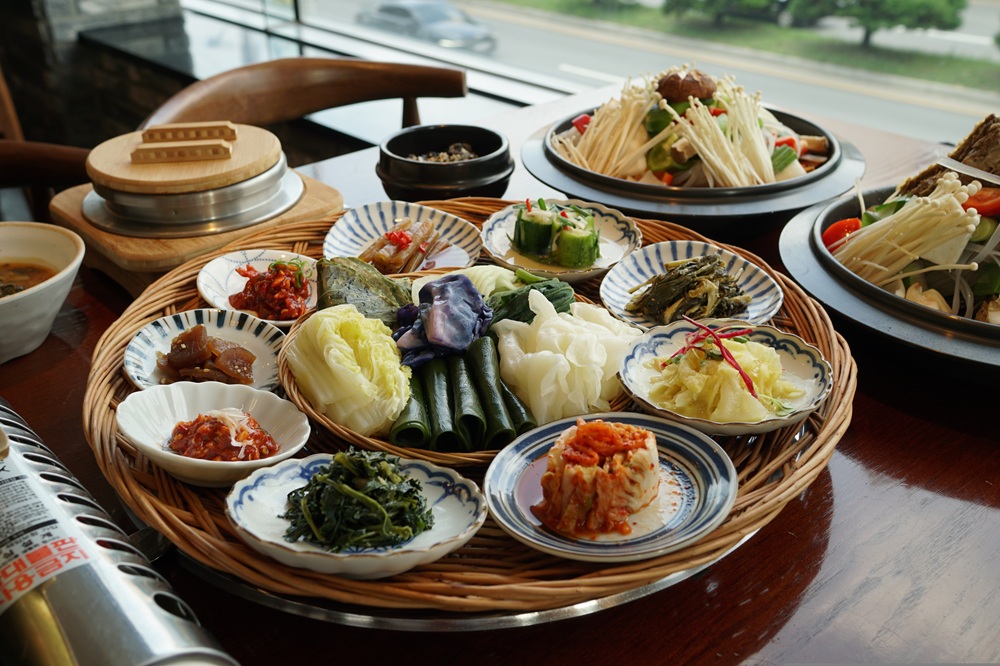
▪"Rice + soup + side dishes" full table · chili-powder heat
Koreans' tables look quite different from the "Asian food" people often picture back home. The biggest feature is the han-sang structure, in which a single meal is set out with rice, soup, and several side dishes together. The heat, too, is built on chili powder and gochujang, so even spiciness has a different flavor from what you ate in your home country. Many restaurants also serve basic side dishes like kimchi and seasoned vegetables for free — and refill them endlessly — a custom that often surprises newly arrived foreigners. If you're not used to spicy food, you can ask for it to be made milder, and it's a good idea to start with gentler dishes and adjust gradually.
3-(2)Basics of the Korean table & spicy flavors
- The staple is white rice — similar to Vietnam and southern China, but Korean rice is stickier and glossier
- A meal consists of: rice + soup (stew) + kimchi + 2–5 side dishes
- There are many kinds of soup and stew (kimchi stew, soybean-paste stew, seaweed soup, seolleongtang…)
- You use a spoon and chopsticks together. You don't lift the bowl to eat (unlike Japan and China)
- At restaurants, kimchi and basic side dishes are refilled free, endlessly
- Spicy foods are very common — kimchi, tteokbokki, ramyeon, dakbokkeumtang, buldak, etc.
- Korean heat is based on chili powder and gochujang → a different kind from Vietnam (the chili in pho) or Uzbekistan (mostly pepper)
- If spicy food is hard for you, "Please make it not spicy" is a phrase that works well at restaurants
- Kimchi is a side dish but can be spicy to foreign palates. There's also baek-kimchi (non-spicy white kimchi)
Where students often eat
- 5,000–7,000 won a meal, with the menu changing daily
- Usually 2–4 counters — Korean, Western, Japanese, snack (bunsik), etc.
- The meal international students use most often
- Gimbap · triangle gimbap · lunchboxes · cup ramyeon · sandwiches
- Open 24 hours → late-night meals and early-morning snacks possible
- Free use of microwave and hot water
3-(3)Dining out, drinking & holiday food culture
Group dinners & drinking culture
Korean universities, departments, clubs, and workplaces have a culture of "hoesik" (everyone gathering for dinner and drinks). Typical examples are the start-of-semester department dinner, club MT (membership training trips), and graduation after-parties. The culture of forcing alcohol has declined a lot compared to the past, but being urged to "have a glass" is still everyday at these gatherings.
If drinking is hard for you, or you can't for religious or health reasons, clearly saying "I can't drink alcohol" is respected by most people. Often they'll pour you a soft drink or cider instead.
Holiday and special-occasion foods
- Seollal (Lunar New Year, lunar Jan 1) — you eat tteokguk (rice-cake soup). There's a joke that eating a bowl makes you a year older
- Chuseok (lunar Aug 15) — you eat songpyeon (half-moon-shaped rice cakes). A holiday like Korea's Thanksgiving
- Birthdays — you eat seaweed soup (miyeokguk). It comes from mothers eating seaweed soup after giving birth
3-(4)Signature dishes · spice levels & dining etiquette
8 staple foods Koreans eat often
These are foods every foreigner runs into at some point in Korea. We've marked the heat level and the per-meal price range, so if you're not strong with spicy food back home, check the heat level before choosing.
- Heat: medium (cabbage + chili powder)
- Price: free as a side dish at restaurants
- Appears on almost every Korean table
- Heat: slightly spicy (gochujang optional)
- Price: 7,000–12,000 won
- Rice + vegetables + egg, mixed with gochujang
- Heat: not spicy (soy-sauce seasoning)
- Price: 12,000–18,000 won per serving
- The safest starter dish for foreigners
- Heat: not spicy (grilled pork)
- Price: 15,000–20,000 won per serving
- Pork → Muslims take note
- Heat: fried not spicy / seasoned medium
- Price: 18,000–25,000 won per whole chicken
- The go-to for late-night snacks and delivery
- Heat: spicy (chili-powder broth)
- Price: 1,000 won a pack at the mart, 4,000–5,000 won at a restaurant
- The best friend of convenience stores and dorm self-catering
- Heat: spicy (gochujang sauce)
- Price: 4,000–6,000 won per serving
- The signature snack of bunsik shops and street stalls
- Heat: not spicy (rice + vegetables + ham)
- Price: 3,000–5,000 won a roll
- The cheapest meal; vegetarian options too
Korea's 5 levels of heat
The heat common back home (Vietnamese chili, Indian masala, Uzbek pepper) is a different kind from Korean heat (chili powder, gochujang). If you're at a lower level, say "Please make it not spicy" in advance at the restaurant.
Basic etiquette at Korean restaurants
- Side dishes refill endlessly — basic sides like kimchi, pickled radish, and bean sprouts can be refilled free
- Water is self-serve — there's a water dispenser at the entrance or end of the table, and you pour it yourself
- Pay at the counter — you don't pay at the table; you settle with staff at the counter on your way out
- No tipping culture — Korea doesn't add a tip. The menu price is the final amount
- Receive drinks with both hands — when an elder or senior pours for you, hold the glass with your right hand and support it with your left, receiving with both hands
- Turn your head to drink — when drinking in front of an elder, it's polite to turn your head slightly to the side
- Pour for others first — before filling your own glass, it's natural to fill the elder's or senior's glass first
- It's polite to pour when a glass is empty (filling before it's finished feels awkward)
3-(5)Dietary restrictions & FAQ
How to find Muslim · vegetarian · halal food
- Itaewon & Hannam-dong, Seoul — about a dozen halal restaurants cluster near the Seoul Central Mosque
- Dongdaemun & Jongno, Seoul — many Indian, Pakistani, and Central Asian restaurants
- Incheon & Ansan — halal and Central Asian restaurants in areas with a high share of foreign workers
- Nampo-dong & 'Texas Street,' Busan — some halal-certified restaurants operating
- Halal restaurants are very rare in smaller provincial cities, so self-catering and cooking is the realistic choice
- Some E-mart and Homeplus stores — run halal-certified chicken and spice sections
- Foreign marts in Itaewon & Dongdaemun — you can buy lamb, halal sausage, and Indian/Middle Eastern spices
- Online like Coupang & Gmarket — search the keyword "halal certified" for nationwide delivery
- Vegetarians find self-catering relatively easy using Korean ingredients like tofu, bean sprouts, mushrooms, seaweed, and gim
Halal, vegetarian & pork — quick Q&A
- Are there halal (Muslim) restaurants? — There are some near Itaewon and the Seoul Central Mosque, and in parts of Busan and Incheon, but they are very few in provincial cities. It's rare for school cafeterias to have a separate halal menu.
- Is it possible to be vegetarian (vegan)? — There are some temple-food and vegan specialty places, but ordinary restaurants almost always use meat, seafood, or fermented fish (jeotgal). "Please leave out the meat" often doesn't work (the broth already has anchovy or meat stock).
- I have to avoid pork — pork is in Korean food very often (kimchi stew, jeyuk-bokkeum, tonkatsu, samgyeopsal). If you see the word "돼지" (pork) on the menu, avoid it.
- Is water free? — Almost every restaurant provides water/a water dispenser free. It's often self-service.
Food-culture questions foreigners often ask
4. Education system
4-(1)Korean education at a glance
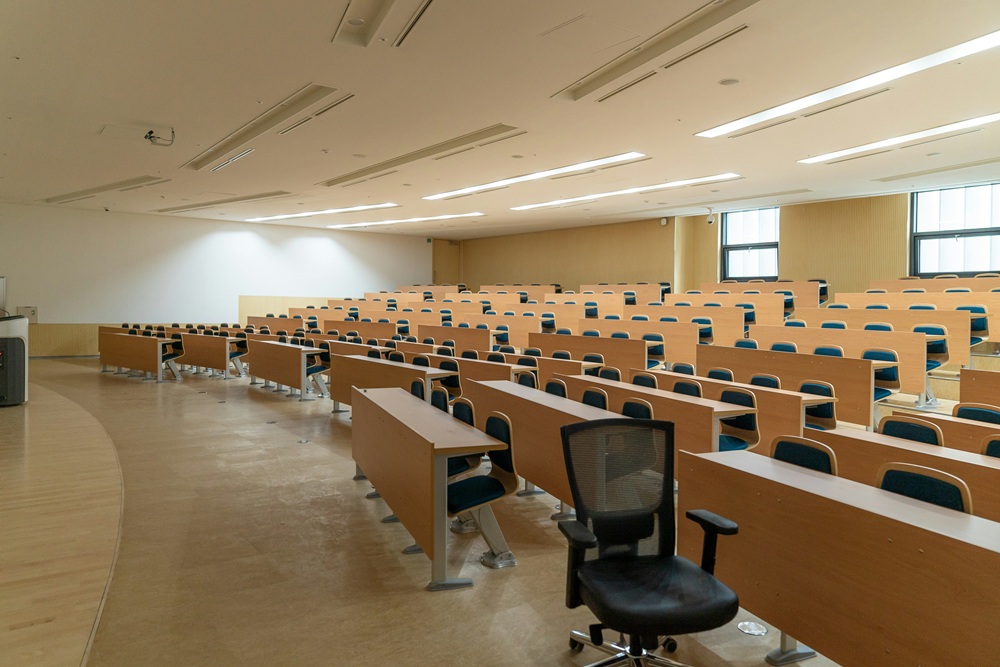
▪The school year starts in March · two semesters a year
The biggest difference to know before going on to a Korean university is that the semester starts in March. A Korean university year is divided into two semesters: the first begins in March and the second usually begins in September. Because this differs from most countries — Vietnam, China, the US — where the new school year starts in September, your entire admission and academic schedule revolves around this Korean-style calendar. As a result, the timing of your visa application, dorm move-in, and tuition payments all need to be prepared around the March start. There can be a gap between when you finish school in your home country and when you enter in Korea, so it's wise to check the schedule in advance.
Semester 1 begins
Spring semester starts
Summer break
Semester 1 ends
Semester 2 begins
Fall semester starts
Winter break
Semester 2 ends
Graduation · advancement
Degree ceremony
4-(2)Four-year universities vs. junior colleges
| Category | 4-year university | Junior college |
|---|---|---|
| Study period | 4 years (5–6 for some majors) | 2 or 3 years |
| Degree | Bachelor's | Associate (professional) degree |
| Education focus | Theory- and research-focused | Practice- and hands-on-focused, tied to certifications |
| Tuition (approx.) | 4–7 million won a semester | About 1.5–4.5 million won a semester (public to private; relatively cheap) |
| After Graduation | Grad school · large companies · civil service | Immediate hands-on employment · SMEs · certification-based professions |
| Number of schools | About 190 schools | About 126 schools nationwide |
This site focuses on studying at a junior college (2–3 years). Junior colleges teach skills you use right away in the field — hotel, culinary, nursing, beauty, media, aviation, automotive, and more — with a strength in landing a job or earning a certification right at graduation.
4-(3)Grading & using your diploma
How you're graded
Korean university grades combine attendance + midterm + final + assignments + presentations + participation. It doesn't end with a single exam — you have to keep up steadily all semester.
What's especially decisive for foreign students is Korean ability. Lectures, textbooks, exams, and presentations are mostly in Korean, so having at least a TOPIK level 3–4 before enrolling is the safe bet (required levels vary by school).
Using your diploma back home — apostille / consular confirmation
To have your Korean junior-college diploma (associate degree) recognized as a qualification back home, you need an apostille or consular confirmation. The procedure differs by whether your country is in the Apostille Convention (China joined in November 2023, Vietnam not yet, etc.), so check with your home country's education ministry or overseas mission in advance.
4-(4)Academic calendar & junior-college majors
Korean academic calendar — at a glance by month
If you're used to a September start back home, Korea's March-start, August-break cycle feels unfamiliar. You have to align your visa issuance, dorm move-in, and flight booking with this flow.
March — Semester 1 starts · new school year begins
Entrance ceremony, orientation, course registration. The most important month, when Korea's new school year begins. New foreign students also go through alien registration at this time.
Term startsApril — midterms
Midterms for about a week in mid-April. Department MTs and sports days are held around this time.
ExamsMay — university festival
Most universities hold their festival in May. With singer performances, night markets, and club booths, it's the liveliest time of the year.
FestivalJune — finals · Semester 1 ends
Finals in mid-June. By late June, Semester 1 ends and summer break begins.
Term endsJuly–August — summer break
About two months off. A time for summer-session classes, part-time jobs, and visiting home. If you have a single-entry visa, be sure to confirm re-entry permission before visiting home.
BreakSeptember — Semester 2 starts
Semester 2 begins in early September. Some schools that admit a September (fall) intake take new students at this time.
Term startsOctober — midterms · Chuseok holidays
Midterms in mid-October. Chuseok on lunar Aug 15 (usually late Sept–early Oct) brings about 3–5 days off.
ExamsDecember — finals · Semester 2 ends
Finals in mid-December. By late December, Semester 2 ends and winter break begins.
Term endsJan–Feb — winter break · graduation · new-term prep
The coldest time of year. Late-February graduation and prep for new foreign students' arrival and alien registration are concentrated here.
BreakThe scale of junior colleges — the picture in numbers
7 categories of junior-college departments
Korea's standard higher-education classification usually uses 5 fields — humanities & social sciences, natural sciences, engineering, arts & athletics, and medicine — and these are sometimes split into 7 by separately highlighting health and nursing. How open each is to foreign students varies by department and school, so be sure to check the admission guidelines before applying.
- Tourism, hotel, aviation service, secretarial, social welfare, business
- Foreign intake: very high (tourism & hotel especially)
- Many schools admit with TOPIK level 3–4
- Automotive, mechanical, electrical/electronic, architecture, civil, computer info
- Foreign intake: medium (high practical share, so Korean is needed)
- Many departments tied to earning certifications
- Food & nutrition, companion animals, environment, marine, agriculture
- Foreign intake: medium
- Many departments centered on experiments and practical work
- Applied music, beauty, hair/makeup, fashion, design, broadcasting/video, acting
- Foreign intake: high (K-beauty & K-content popularity)
- Heavy weight on practical exams and portfolio evaluation
- Dental hygiene, physical therapy, occupational therapy, clinical pathology, radiology
- Foreign intake: low (national exam required · capped enrollment)
- Many 3-year departments
- Emergency rescue, health administration, dental technology, optometry
- Foreign intake: low–medium (Korean needed for practical work)
- Earning a national certification is the key
- Nursing department (3-year or 4-year)
- Foreign intake: very low (nurse national exam taken in Korean)
- One of the most popular and competitive departments
4-(5)Senior–junior culture & FAQ
Class-year · senior-junior · forms of address (in detail)
- Hakbeon is the two-digit entrance year + a class number. Entering in 2026 = the "'26 class"
- Students who entered the same year call each other "donggi" (peers) (regardless of age)
- A student who entered even a year earlier is a "seonbae" (senior); one who entered later is a "hubae" (junior)
- Because of returning students who've done military service, ages can differ a lot even within the same year
- Foreign students are automatically assigned a class year too — independent of their year or age back home
- Male senior, as called by a male = hyeong
- Female senior, as called by a male = nuna
- Male senior, as called by a female = oppa
- Female senior, as called by a female = eonni
- The department office and professors are always "gyosunim" (professor) / "seonsaengnim" (teacher)
- At first you call them "seonbae-nim," then naturally switch to hyeong, nuna, etc. once you're close
Clubs · MT — a great channel for foreigners to make friends
- Department club — an academic or hobby club of students from the same department. Strong class-year hierarchy
- Campus-wide club — a club of students from across the whole school (sports, music, volunteering, religion, etc.). A mix of various departments and years
- International-student associations and exchange clubs are the easiest for foreigners to join. Many Korean students also join to exchange Korean and foreign languages
- Sign-ups are taken at the club fair at the start of the March term
- A bonding trip a department or club takes together for 1 night / 2 days or 2 nights / 3 days
- Usually games, meals, drinking, and self-introduction time at a pension or dorm-style lodging
- The new-student welcome MT at the start of term (March/September) is the biggest
- The fee is usually 30,000–70,000 won; foreign students are welcome too, but it's your own choice to go
- If you don't drink or have religious reasons, letting the student council or class rep know in advance gets you accommodated