E-7 employment, F-2 residence, F-5 permanent residency — the stages of settling in Korea
1. E-7 Specific Activity Visa
1-(1)E-7 visa at a glance
▪Professional and semi-professional work visa for employment in designated occupations specified by the Ministry of Justice
This is the official work visa issued to foreigners hired into jobs that match the professional, semi-professional, or skilled-worker occupation codes designated by the Ministry of Justice. Simply finding a job is not enough: your academic major and the actual duties of the position must line up within the same occupation code, and you must also meet the set salary threshold. For junior college graduates in particular, there is a separate E-7-M route available when you are hired by a business outside the Seoul metropolitan area, which can meaningfully lower the entry barrier for international students hoping to begin their careers in a regional part of Korea.
1-(2)E-7 types and requirements compared
- Target: Employment in designated occupations by the Ministry of Justice (professional, semi-professional, skilled worker)
- Standard education: Bachelor's degree or higher (exceptions apply for certain occupations)
- Major-occupation match required
- The Ministry of Justice announces salary requirement standards annually (separate announcement for 2026 standards)
- For graduates of Korean junior colleges (linked to K-CORE program)
- Requires employment at a business outside the Seoul metropolitan area
- Relaxed education and financial requirements compared to general E-7 (financial proof waiver pilot program in operation)
- A separate pathway to address regional labor shortages
| Category | General E-7 | E-7-M (Regional specialization) |
|---|---|---|
| Primary target | Professionals with bachelor's degree or higher and matching major | Graduates of domestic junior colleges |
| Work location restriction | Nationwide | Designated businesses outside the Seoul metropolitan area (excluding Seoul, Incheon, Gyeonggi) |
| Education requirement | Bachelor's degree or higher as a rule | Associate degree recognized (relaxed requirements) |
| Financial proof | Must meet salary requirement standards | Financial proof waiver applied during pilot program period |
| Major-occupation match | Strict (matched to occupation code) | Linked to departments based on regional industry demand |
| Long-term stay pathway | Eligible to enter F-2 points system | Eligible to enter F-2 points system (with regional bonus points) |
In the context of E-7-M, "non-metropolitan area" refers to metropolitan cities and provinces excluding Seoul, Incheon, and Gyeonggi. This applies only to junior college-nurturing departments and businesses designated by the Ministry of Justice, and separate recommendation procedures and preferred department lists are operated by each local government and school.
1-(3)Application documents and eligibility check
- Visa application form · passport copy · passport-size photo
- Employment contract (specifying E-7 occupation code, meeting salary requirements)
- Employer's business registration certificate · corporate registry certificate
- Degree certificate · academic transcript (proving major-occupation match)
- Certificate of career experience (if applicable)
- For E-7-M: local government recommendation letter · proof that workplace is outside Seoul metropolitan area
- Korean language proficiency proof (TOPIK · KIIP) — required level varies by occupation
- Is the hiring company's occupation included in the Ministry of Justice E-7 designated occupation codes?
- Does your major match the hired occupation? (Check the department–occupation link table)
- Does the employment contract salary meet the E-7 salary requirement announced for that year?
- (E-7-M) Is the workplace outside the Seoul metropolitan area, and can you obtain a local government recommendation?
- (E-7-M) Has your school received International Education Quality Assurance or K-CORE certification?
| Who this visa suits | Who this visa does not suit |
|---|---|
| Those who have a confirmed job offer where major and occupation match and salary requirements are met | Those taking simple labor jobs unrelated to their major |
| Domestic junior college graduates hired at businesses outside the Seoul metropolitan area (E-7-M) | Associate degree graduates wishing to work in Seoul, Gyeonggi, or Incheon (E-7-M not available) |
| Graduates planning for long-term settlement and entry into the F-2 points system | Those whose sole purpose is short-term stay or part-time-level work only (consider E-9 etc. separately) |
1-(4)Frequently asked questions
2. F-2 Residence Visa
2-(1)F-2 visa at a glance
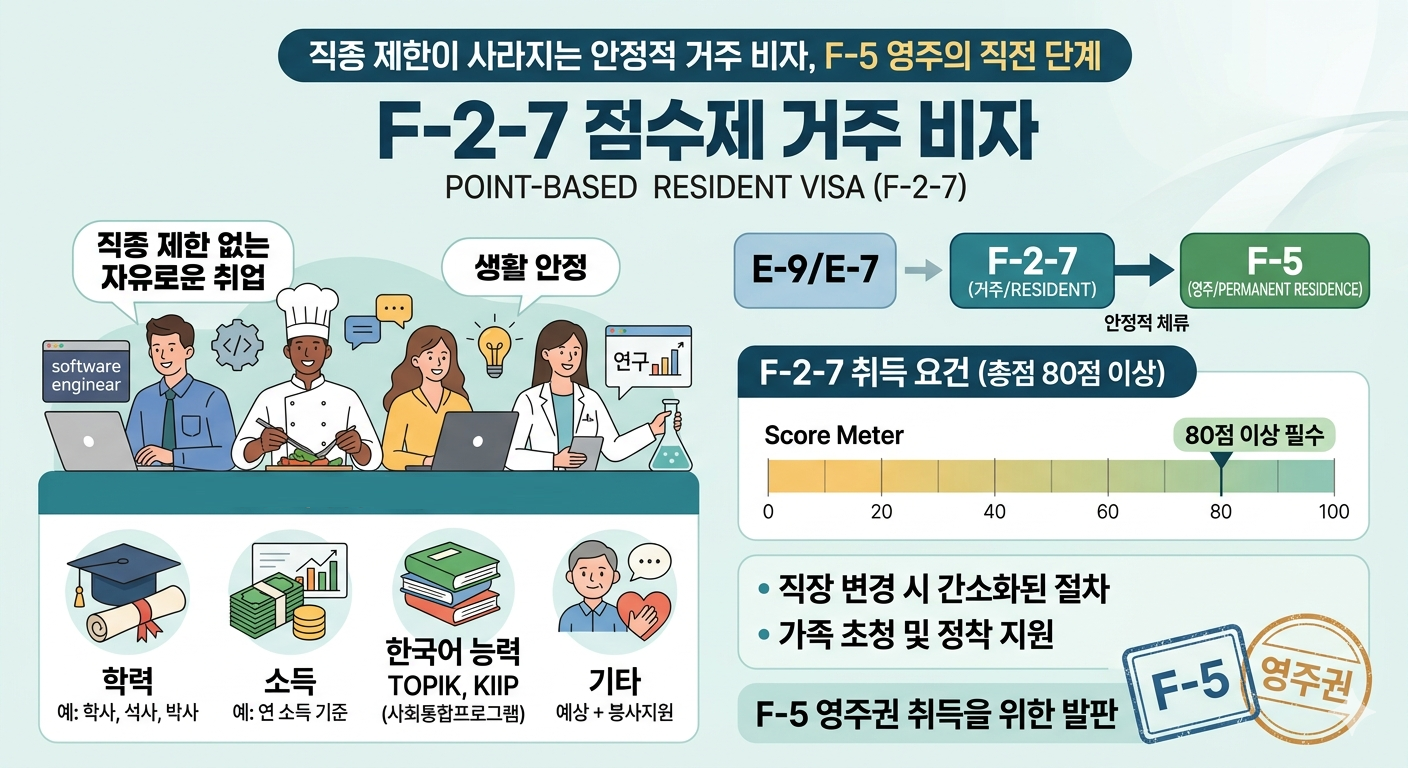
▪A stable residence visa with no occupation restrictions, the step just before F-5 permanent residency
This is a residence status that lets foreigners who have lived stably in Korea for a certain period work relatively freely, without the constant burden of matching their job to a specific occupation or employer. A major advantage is that you no longer have to re-qualify every time you change workplaces, which makes daily life far more stable. The primary route to obtain it is the F-2-7 points system, which converts factors such as education, income, and Korean language ability into a score, and you need a total of 80 points or more. Because it removes occupation restrictions, it is effectively the key stage just before F-5 (permanent residency).
2-(2)A closer look at the F-2-7 points system
- Target: Foreigners who have lived stably in Korea for a certain period
- Primary pathway: F-2-7 points system talented resident visa
- No restrictions on employment occupation (no need to match company or occupation like E visa)
- The stage directly before F-5 (permanent residency)
| Item | Max points | Key criteria |
|---|---|---|
| Age | 25 points | Graduated by age group: middle-aged and youth brackets |
| Education | 25 points | Korean degree · bonus for top world universities |
| Korean language ability | 20 points | TOPIK or Social Integration Program |
| Annual income | 60 points | Immediately eligible to apply when annual salary is 40 million KRW or more |
| Bonus points | 40 points | Domestic degree, certifications, volunteer activities, etc. |
| Deductions | -80 points | Violations of laws, tax delinquency, etc. |
Passing threshold: total score of 80 or above (income carries the greatest weight)
2-(3)Application documents and eligibility check
- Integrated application form · passport-size photo · passport copy
- F-2-7 points system evaluation form (self-completed)
- Degree certificate · academic transcript (Korean degree applies bonus points)
- Korean language ability proof (TOPIK score report or KIIP completion certificate)
- Income proof (withholding tax receipt for earned income · income amount certificate, etc.)
- Certificate of employment · career certificate
- Tax payment certificate · personal background check consent form
- Are you currently legally staying on a changeable status such as E-1 to E-7 or D-10?
- Is it possible to reach 80 or more points in the points system evaluation? (income, education, Korean language)
- Do you have key cards such as an annual salary of 40 million KRW or more, or a Korean degree bonus?
- Have you had no violations of immigration laws or tax laws in the past year or more? (check for deductions)
- Is your plan clear for the residence period (3 years) leading up to F-5?
| Who this visa suits | Who this visa does not suit |
|---|---|
| E-7 holders with a Korean degree and stable salary | Those far below the 80-point threshold (safer to stay at D-10 or E-7 stage) |
| Long-term settlers who want the flexibility to change employers or occupations | Those with significant deduction factors such as recent immigration law violations or tax delinquency |
| Those who will steadily accumulate points step by step toward F-5 permanent residency | High-income earners with no Korean language proof (TOPIK · KIIP) at all (risk of insufficient points) |
2-(4)Frequently asked questions
3. F-5 Permanent Residency Visa
3-(1)F-5 visa at a glance
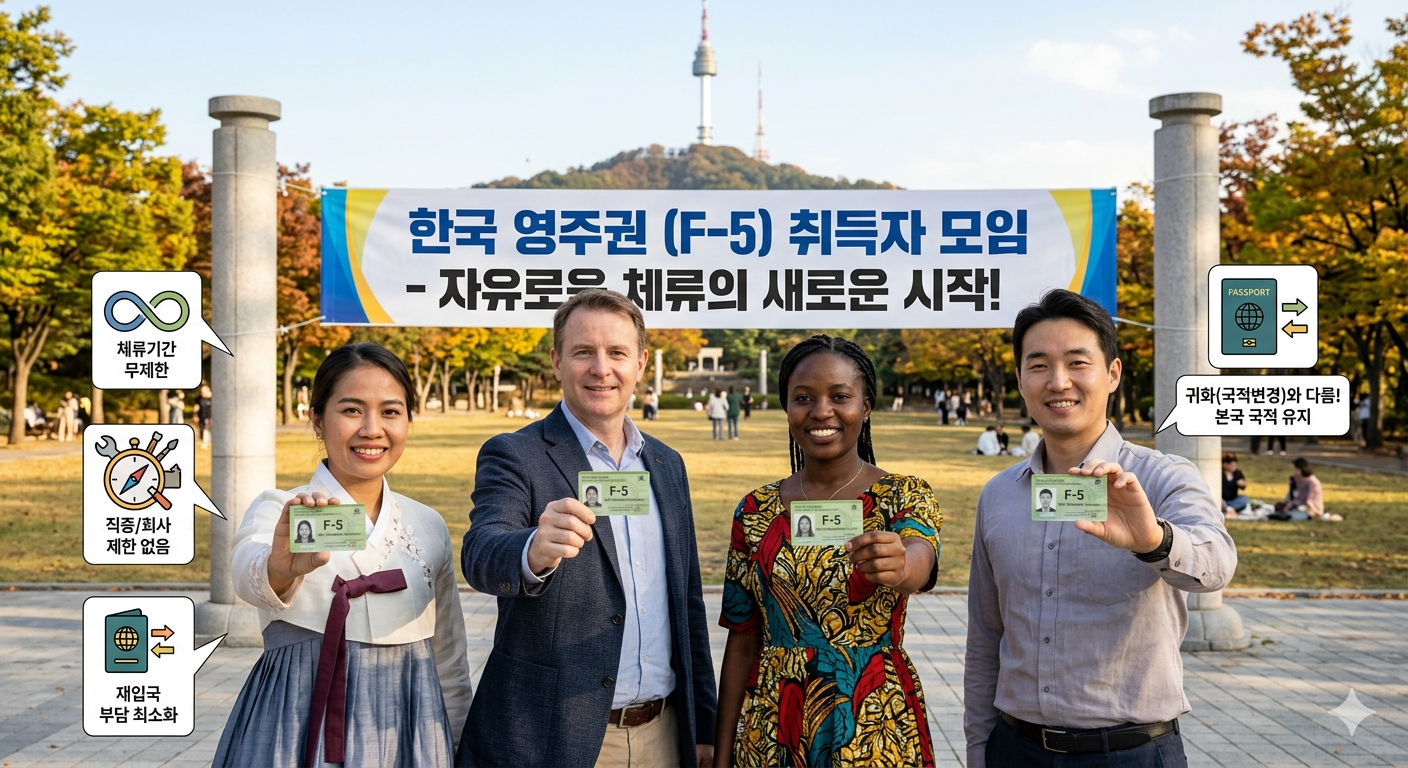
▪The final destination: a visa for permanent residence in Korea
This is effectively the final destination of foreign residency status: an unlimited period of stay, no occupation or employer restrictions, and minimal re-entry burden each time you leave and return to the country. The status is divided into a total of 27 subcategories, so applicants can choose the route that fits their situation, and regardless of which subcategory you apply under, the common requirements are good moral conduct, the ability to support yourself financially, and basic proficiency in the Korean language and Korean social norms. An important distinction, however, is that unlike naturalization—which changes your nationality—obtaining permanent residency lets you keep your original nationality.
3-(2)F-5 categories and benefits
- Target: Foreigners recognized for permanent residence in Korea
- Unlimited stay, no occupation or employer restrictions, minimal re-entry permit burden
- Subdivided into a total of 27 subcategories (status classifications)
- Common requirements: good moral conduct + ability to support oneself + basic Korean language and social norms
| Classification | Target | Key requirements |
|---|---|---|
| F-5-1 | General permanent residency | Adults who have stayed 5 or more years on D-7 to D-10, E-1 to E-7, F-2, etc. |
| F-5-10 | Persons with outstanding ability in a specific field | Proven outstanding ability in science, business, culture, arts, sports, etc. |
| F-5-16 | Points-based permanent residency | Those who have stayed 3 or more years on F-2-7 points-based residence visa |
All subcategories include various pathways such as marriage immigration, investment, overseas Koreans, and refugees.
- No more burden of annual or triennial stay extension applications (unlimited stay)
- Freedom to change jobs, start a business, or take leave (no occupation or employer code matching required)
- Improved access to Korean social infrastructure such as loans, rental housing, and credit
- Minimal re-entry permit burden (free re-entry within a certain period after departure)
- Separate from naturalization — original nationality can be maintained
3-(3)Application documents and eligibility check
- Integrated application form · passport-size photo · passport copy · alien registration card
- Personal guarantee letter · criminal record certificate (issued by home country, apostilled)
- Proof of ability to support oneself (income certificate · employment certificate · real estate · financial assets)
- Korean language ability proof (TOPIK or KIIP Level 5 completion)
- Proof of residence period (alien registration fact certificate, etc.)
- Additional documents per subcategory (F-5-1 requires proof of previous status; F-5-16 requires F-2-7 points table, etc.)
- Do you meet the stay period requirement for the relevant subcategory? (F-5-1 is 5 years; F-5-16 is 3 years)
- Have you had no violations of immigration law, tax law, or criminal law recently? (good moral conduct requirement)
- Can you prove the ability to support yourself or your cohabiting family members?
- Do you meet Korean language ability (TOPIK · KIIP Level 5) or qualify for an exemption?
- Has the residence requirement not been broken by a long absence (gap) during your stay period?
| Who this visa suits | Who this visa does not suit |
|---|---|
| Graduates and workers who have stably stayed on F-2 or E-7 for 5 or more years | Those who do not meet the residence period requirement (below the relevant subcategory standard) |
| Those who want to build a family and asset base in Korea and operate their occupation freely | Those whose return to their home country is imminent and who only need a short-term stay |
| Those who want permanent residence in Korea without naturalization | Those who have difficulty proving basic Korean language and social norms proficiency (not completing KIIP, etc.) |
3-(4)Frequently asked questions
4. Full flowchart
4-(1)Settlement pathway at a glance
The 5-stage pathway: study → job-seeking → employment → residence → permanent residency
This is a standard pathway that summarizes, in a single line, the visa stages a Korean junior college international student passes through from arrival to settlement: study → job-seeking → employment → residence → permanent residency. It is useful for grasping the overall flow at a glance, but this sequence does not apply identically to everyone. Depending on your occupation, level of education, income, and Korean language ability, some people skip intermediate stages, while others must satisfy additional requirements before they can move on to the next one—so it is important to review the pathway against your own circumstances.
4-(2)Step-by-step visa flow
D-2 (Study)
The basic student visa while enrolled in a regular Korean degree program.
While enrolledD-10 (Job-seeking)
A visa allowing legal stay during the period of job-hunting after graduation.
Up to 2 years after graduationE-7 / E-7-M (Employment)
The official work visa to switch to upon confirmed employment. For junior college graduates, the E-7-M route is the key pathway.
Upon confirmed employmentF-2 (Residence)
Upon passing the points system evaluation, you transition to a stable residence visa with no occupation restrictions.
Several years after employmentF-5 (Permanent Residency)
The final stage with permanent residence recognized in Korea — stay, employment, and re-entry are unrestricted.
A certain period after F-2D-2 (Study) → D-10 (Job-seeking) → E-7 / E-7-M (Employment) → F-2 (Residence) → F-5 (Permanent Residency)