Bachelor's transfer, graduate school, startup, or returning home.
1. Bachelor's Transfer & Graduate School
1-(1)Transfer & Graduate Study at a Glance

▪Associate degree → Transfer to year 3 of a 4-year university → Bachelor's → Master's
The standard admission requirement for Korean graduate schools is a bachelor's degree or higher, so applying directly to a master's program with only an associate degree is, in principle, not possible. For this reason, the most common and stable route is to climb the ladder step by step. First you graduate from a junior college, then transfer into the 3rd year of a 4-year university to earn a bachelor's degree, and only then move on to graduate school. By continuing your studies this way, the D-2 (study abroad) visa is renewed naturally and your residence status never lapses, making it the safest choice from a visa standpoint as well. It may take time, but following this proven path is the surest approach.
Junior College Graduation
Earn Associate Degree
Transfer to Year 3 of 4-Year University
Apply through special foreign student admissions
Earn Bachelor's Degree
2 ~ 2.5 additional years of study
Proceed to Graduate School
Only the D-2 sub-code changes (D-2-3)
Besides finding employment right after graduating from a junior college, you can also transfer to a 4-year bachelor's program or proceed to graduate school. Continuing your studies is a safe choice as your residency status (D-2) carries over naturally, but you should plan ahead for the additional time and cost involved.
- Those who have graduated or are expected to graduate from a domestic or international junior college (2-year or 3-year program) may apply for a 3rd-year bachelor's transfer at a 4-year university.
- Most foreign applicants are recruited through a "special foreign student admissions" track, which is a quota outside the regular enrollment, so the competition ratio is often lower than for general transfer applicants.
- Most schools require foreign students admitted to undergraduate programs to obtain TOPIK Level 4 or higher before graduation as a graduation requirement (varies by school).
- Final school graduation certificates and transcripts issued in your home country must go through apostille or consular legalization procedures.
1-(2)Transfer Process & Application Schedule
5 Steps for Foreign Bachelor's Transfer Admission
Choose School & Major
Narrow down 4-year universities that offer foreign student transfer admissions, and prioritize departments where your major and the range of transferable credits are a good match.
D-6 ~ 4 monthsCheck Recruitment Guidelines & Prepare Documents
Prepare graduation certificates, transcripts, financial documents, TOPIK scores, personal statement, and study plan according to each school's format. Foreign documents may require notarization and consular certification.
D-4 ~ 2 monthsTransfer Exam & Interview
Depending on the school, assessment includes English, major subject, and Korean language exams plus an interview. The foreign student track is often focused on documents and interviews.
D-2 ~ 1 monthAcceptance & Credit Recognition Review
After acceptance, the department reviews how many credits from your junior college will be recognized. The graduation timeline varies depending on the range of credits accepted.
1 month after acceptanceEnrollment & D-2 Renewal
Pay tuition fees and update (or renew) your D-2 visa information using the new school's standard admission letter. This is a form of changing only the school within the same D-2 visa.
Before the semester startsForeign Bachelor's Transfer Application Period
| Semester | Application Period | Selection & Announcement | Admissions |
|---|---|---|---|
| Spring Semester (First Half) | October ~ December of the previous year | December ~ January | March |
| Fall Semester (Second Half) | May ~ July of the current year | July ~ August | September |
| Additional Recruitment by School | Rolling basis when vacancies arise | Results within 1~2 weeks | Applicable semester |
※ Schedules vary by school. Please check the 2026 academic year foreign student special admissions guidelines for the school you are applying to directly.
1-(3)Visa, Scholarships & Path Comparison
- The standard admission requirement for Korean graduate schools is a bachelor's degree or higher. Applying directly to a master's program with only an associate degree is generally not possible.
- As an exception, if you are recognized as having a qualification equivalent to a bachelor's degree through the Credit Bank System, the Independent Degree Examination, industry experience, etc., you may be able to apply to some graduate schools (varies by school and major).
- The most common path is: junior college graduation → bachelor's transfer (year 3) → earn bachelor's degree → graduate school.
- Some schools offer a separate opportunity for associate degree holders with industry experience to apply to "industrial graduate schools or professional graduate schools."
- For a transfer, you simply change the affiliated school within the same D-2 visa. You report the change to immigration using the new school's standard admission letter.
- For graduate school, only the sub-code within D-2 changes (D-2-2 bachelor's → D-2-3 master's → D-2-4 doctoral).
- If there is a gap between graduating from the junior college and enrolling at the new school, that period is typically handled with D-10 (job-seeking) status or a general visitor visa.
- It is also possible to change to D-10 just before transferring or enrolling, then revert to D-2.
- On-campus foreign student scholarships — Most 4-year universities offer merit-based tuition reductions (30~70%) for foreign transfer students as well.
- Government Scholarship (GKS) — The undergraduate track is usually based on freshman admission, but some schools separately provide on-campus scholarships for transfer students as well.
- Local governments & private foundations — Tuition support programs targeting foreign international students residing in the region are growing (e.g., provincial/city scholarship foundations).
- Transfer students often have fewer scholarship options than freshmen, so be sure to confirm directly with the department office before applying.
Comparing Further Study vs. Employment
| Category | Transfer / Further Study | Immediate Employment |
|---|---|---|
| Additional Time | Minimum 2 years (bachelor's transfer) ~ 4~5 years (including master's/doctoral) | None (immediately after graduation) |
| Additional Cost | Tuition + living expenses (partially offset by scholarships) | None (income generated) |
| Stay Stability | Stable with D-2 maintained | May vary through D-10 → E-7 stages |
| Career Value | Obtain bachelor's/master's qualifications; higher ceiling on job roles & salary ↑ | Gain practical work experience immediately; faster market entry |
| Home Country Utilization | Higher degree level = wider recognition in home country ↑ | Leverage Korean work experience + associate degree |
- Credit recognition limits — Only some of the courses taken at your junior college may be recognized, so even transferring as a 3rd-year student, actual graduation can take 2.5~3 years.
- Delayed graduation — If you need to take extra semesters due to insufficient credits, tuition and living expenses will increase.
- Adjusting to a new school — Friends, professors, and administrative systems are all new, so the academic burden in the first semester is heavy. It is even harder if your Korean proficiency is insufficient.
- Major differences — Even with the same department name, 4-year universities are theory- and research-oriented while junior colleges are practice-oriented, so the classroom atmosphere is different.
1-(4)Frequently Asked Questions
Transferring to a 4-year university after junior college is the safest way to expand your career options. Just don't forget that it means investing more time and money.
2. Startup (D-8) · K-Startup
2-(1)Startup Visas at a Glance
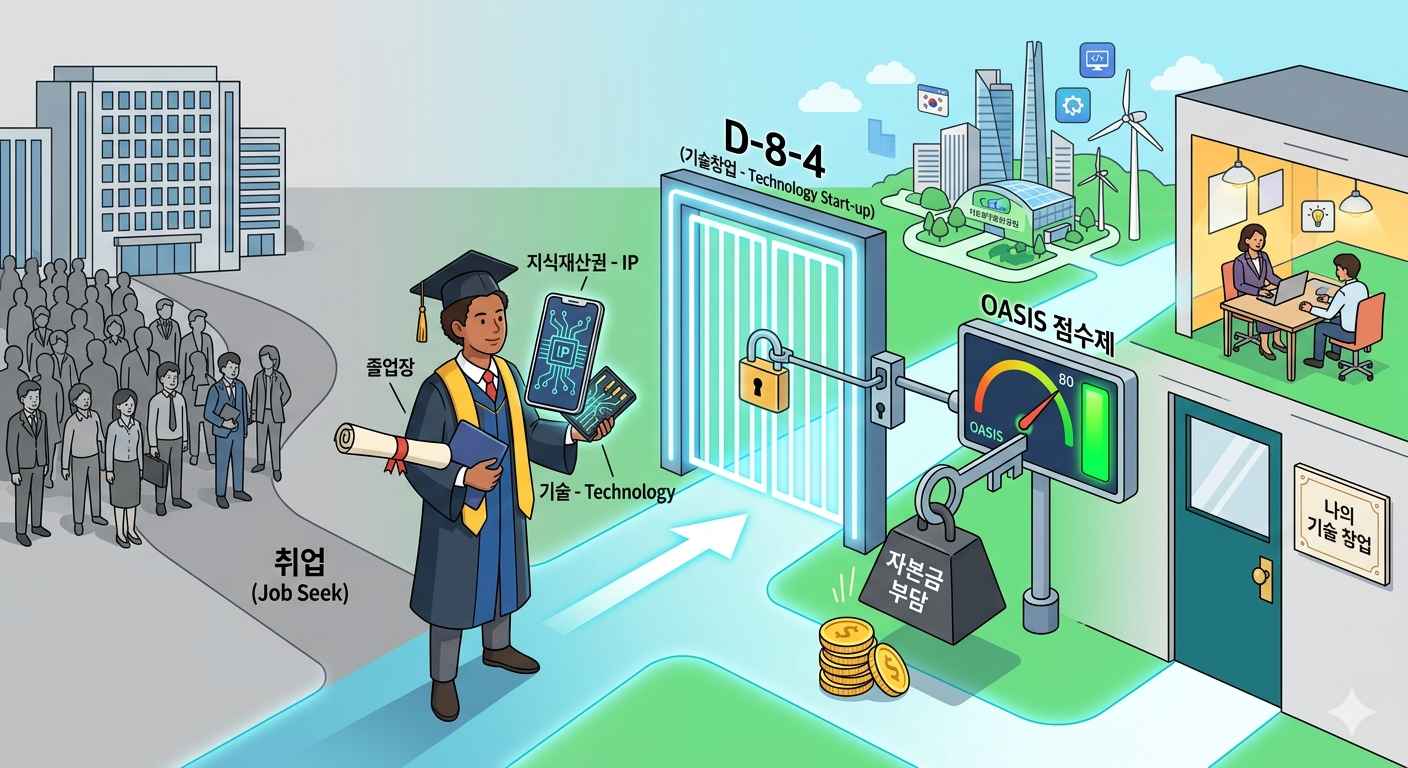
▪For junior college international students, D-8-4 technology startup is the key path
Foreigners in Korea who hold a degree and technical skills can open up a career path through entrepreneurship as well as employment. The D-8 visa tied to startups is itself divided into four sub-codes (D-8-1, D-8-2, D-8-3, D-8-4), and for international students who combine an associate degree with intellectual property rights, D-8-4 (technology startup) is the most realistic option, since it lets you launch a business based on technology or ideas you already own. On top of that, scoring 80 points or more under the OASIS point system eases the capital requirement for starting a company, opening a viable path even for students who do not have abundant funds.
-
D-8-1 Working at a Foreign-Invested Company
Executives/employees dispatched or employed at a Korean company invested by foreigners (not self-founding)
-
D-8-2 Foreign Investor
Large-scale capital transfer + establishment of a Korean corporation
-
D-9 Trade & Business Management
Directly operating a trade/import-export business in Korea
-
D-8-4 Technology Startup (Key for international students)
Domestic associate degree or higher + intellectual property rights + OASIS score of 80 or more
Foreigners with a junior college degree and technical skills in Korea can open career paths through startup as well as employment. The Korean government operates a separate visa track (D-8) and the K-Startup support program for foreign entrepreneurs.
- For executives/employees dispatched or employed at a Korean company invested by foreigners
- Foreign investment company registration + position/salary requirements
- Not a visa for starting your own business
- You are registered as an investor under the Foreign Investment Promotion Act
- Transfer of capital above a certain amount + establishment of a Korean corporation
- Large-scale capital-based startup/investment path
- Directly operating a trade/import-export business in Korea
- Business registration, trade business declaration + performance requirements
- Suitable for trade/distribution business connecting your home country and Korea
- Domestic associate degree or higher + intellectual property rights/technical capability
- Capital burden reduced if you pass the OASIS point system (80 points or more)
- The most realistic startup visa for international students who graduated from a junior college in Korea
2-(2)D-8-4 Tech Startup Requirements & Points System
- Education — Domestic associate degree or higher (limited to those who have already obtained it, not expected graduates) or an overseas bachelor's degree or higher + possession of intellectual property rights/technical capability.
- Technology — You hold intellectual property rights such as patents, utility models, designs, copyrights, etc. in your own name, or possess equivalent technical capability.
- Corporation establishment — Establishment and registration of a Korean corporation, plus business registration completed.
- Score — Obtain 80 points or more out of a total of 368 points in the OASIS point system (must meet at least 1 mandatory item).
- Recommendation from a central administrative agency — Those recommended by a relevant ministry are also recognized through a separate track.
Main OASIS Point System Items (Examples)
| Category | Item | Score Example |
|---|---|---|
| Education | Domestic associate degree / bachelor's / master's or doctoral | Points added by degree level |
| Intellectual Property Rights | Holding patents, utility models, designs, copyrights (mandatory item) | Points added by type and number |
| OASIS Training Completion | OASIS Courses 1 & 2 (intellectual property literacy training) | Points added upon certificate issuance |
| Korean Language Proficiency | TOPIK levels | Points added by level |
| Capital / Revenue | Corporate capital, performance, number of employees | Points added by amount and number of people |
| Awards | Awards at startup competitions and technology contests | Points added by competition scale |
※ Exact scores and detailed items are revised annually by Ministry of Justice notice. Before applying, confirm the latest score table via Hi Korea or immigration consultation.
2-(3)Startup Support Programs & Procedure
- K-Startup Portal (k-startup.go.kr) — Integrated announcement of all startup support projects from central ministries and local governments. Projects that foreigners can apply for are separately marked.
- Pre-startup Package · Early Startup Package — Bundled support including commercialization funding, mentoring, and training. Rounds open to foreign participation are operated every year.
- K-Startup Center / Global Startup Academy — Accelerating and overseas expansion support for foreign entrepreneurs looking to enter the Korean market.
- Seoul Global Center OASIS Program — Comprehensive foreign startup support operated by Seoul city. Directly linked to OASIS point bonus items.
- Local government startup support funds — Non-metropolitan local governments operate office space and settlement subsidies for foreign entrepreneurs. Depending on the region, there may also be OASIS score bonus effects.
6 Steps for Foreign Startup Procedures
Business Planning & Market Research
Prepare a business plan in Korean and English outlining the item, target market, competitors, and revenue model. Start OASIS training completion at this stage as well.
D-6 ~ 3 monthsCorporation Establishment & Capital Payment
Establish a Korean corporation (e.g., joint-stock company) and complete the corporate registration. D-8-4 has more relaxed capital requirements than general D-8-2, but the minimum capital for OASIS score bonuses must be planned in advance.
D-3 ~ 2 monthsBusiness Registration & Securing Office Space
Complete business registration at the competent tax office and sign a lease for an office (co-working spaces are also acceptable). Immigration review examines the physical presence of the office space.
D-2 monthsConfirm OASIS Score & Apply for Visa
Pre-calculate your score and make up for any shortfalls (training, qualifications, revenue). Submit the D-8-4 application form, business plan, and corporate documents to immigration.
D-1 monthVisa Issuance & Alien Registration
After D-8-4 is issued, renew the alien registration card. Family accompaniment (F-3) applications can also be processed at this time.
Within 90 days of issuanceBusiness Launch & Operations
Set up accounting, 4 major insurances, and tax reporting systems, and start generating actual revenue and employment. This leads onward to applying for F-5 permanent residency (3+ years of stay + investment/employment requirements).
Business operations- IT & Software — Web/app development, games, AI solutions. Easy to secure intellectual property rights, advantageous for OASIS scores.
- Content & Media — YouTube/SNS production, Korean cultural content export, translation and subtitle services.
- Beauty & Fashion — Korean cosmetics/fashion distribution connected to home country markets, launching own brands.
- Food & Dining — Introducing home country cuisine to Korea, or exporting Korean food to your home country.
- Trade & Distribution — Two-way trade between home country ↔ Korea. Often connected to the D-9 (trade management) track.
2-(4)Things to Check Before Starting a Business
- D-8-4 requires ongoing business performance for renewal. If revenue and employment disappear, renewal refusal or qualification cancellation is possible.
- When dissolving or closing a corporation, you must report to immigration, and if you do not change to a new status (D-10, E-7, etc.), you become subject to departure.
- Tax arrears, unpaid 4 major insurance premiums, and wage theft come back to you as the corporate representative in the form of criminal and civil liability. They are also recorded directly in Korean credit information.
- If funds remitted from your home country are not reported under the Foreign Exchange Transactions Act, they are subject to separate penalties.
- D-2 students are free to "prepare" for a startup (organizing ideas, completing training, writing business plans).
- However, if you register a business or start for-profit activities in your own name while in D-2 status, it becomes an activity outside your status, which is a violation.
- To formally launch a startup, you must change to D-10-2 (startup preparation) or D-8-4 (technology startup) after graduation before registering your business or establishing a corporation.
- D-10-2 is a status for the "startup preparation" stage, serving as a bridge visa when your OASIS score is still insufficient.
2-(5)Frequently Asked Questions
Starting a business is a flexible visa path, but it requires prior experience running a real business and an understanding of the Korean market.
3. Home-Country Degree Recognition
3-(1)Degree Recognition at a Glance

▪Apostille member countries vs. non-member countries — the procedures are completely different
An associate degree earned in Korea is not automatically recognized in your home country; it only takes effect after going through a set certification procedure. And that procedure changes completely depending on whether your home country has joined the Apostille Convention. If your home country is a member of the Apostille Convention (Uzbekistan, Mongolia, China), the process is simple: you only need a single apostille certification from the Korean Ministry of Foreign Affairs. For a non-member country (Vietnam), however, you must obtain Korean consular certification, then go through home-country consular certification, and finally secure degree recognition from a home-country evaluation agency, so there are far more steps and it takes more time. It is wise to confirm your home country's rules in advance.
Apostille Member Countries
- Uzbekistan · Mongolia · China (effective November 2023)
- Only one apostille issuance from the Korean Ministry of Foreign Affairs
- Approx. 2 ~ 10 weeks
- Cost approx. 50,000 ~ 200,000 KRW
Apostille Non-Member Countries
- Vietnam
- Dual consular certification from Korean Ministry of Foreign Affairs + home country embassy
- Approx. 4 ~ 8 weeks
- Cost approx. 100,000 ~ 250,000 KRW
The procedure for recognizing an associate degree obtained in Korea differs by country. If you want to use your degree upon returning to your home country, you need to confirm in advance.
3-(2)Degree Recognition Procedure Comparison by Home Country
Procedures, timeframes, and costs differ by country of origin. If processed in Korea immediately after graduation, it can be used right upon arrival in your home country.
| Country | Convention Status | Procedure Steps | Estimated Time | Estimated Cost |
|---|---|---|---|---|
| Vietnam | Non-Apostille Member | Notarization → Korean Ministry of Foreign Affairs consular certification → Vietnamese Embassy in Korea consular certification → Home country Ministry of Education and Training degree recognition | Approx. 4~8 weeks | 100,000~250,000 KRW |
| Uzbekistan | Apostille Member | Notarization → Korean Ministry of Foreign Affairs apostille issuance → Home country Ministry of Education NOSTRIFICATION (degree equivalency recognition) | Approx. 2~6 weeks | 50,000~150,000 KRW |
| Mongolia | Apostille Member | Notarization → Korean Ministry of Foreign Affairs apostille issuance → Home country Ministry of Education degree evaluation and registration | Approx. 2~5 weeks | 50,000~120,000 KRW |
| China | Apostille Member (effective November 2023) | Notarization → Korean Ministry of Foreign Affairs apostille issuance → Chinese Ministry of Education Center for Student Service and Development (CSCSE) academic credential verification | Approx. 4~10 weeks | 100,000~200,000 KRW |
3-(3)Using Your Career & Converting Credentials After Returning Home
- Korean company local subsidiaries/corporations — Hiring at local corporations of Samsung, LG, Hyundai, SK, Lotte, etc.
- Korean language teachers — Expanding Korean language courses in regular schools in Vietnam, Uzbekistan, and Mongolia
- Interpreters/Translators — Business, legal, and medical interpretation qualifications
- Tourism & Aviation Guides — Inbound market for Korean tourists
- Trade & Logistics — Working in Korea-ASEAN and Korea-CIS trade lines
- K-Content & E-commerce — Local distribution of Korean cosmetics, food, and daily necessities
- Nursing — Sit for national exam after home country Ministry of Health recognizes the degree
- Beauty & Cosmetology — Conversion exam at home country vocational training institutes
- Automotive Maintenance — Korean Human Resources Development Service qualifications recognized in some countries
- Hotel & Culinary — Grade assigned after home country Ministry of Tourism certification
- IT & Information Processing — In many cases, degree recognition alone can be used for employment
- For licensed occupations, further study or re-education in your home country may be required, so it is recommended to confirm before graduation
- Vietnam — Under resolutions to attract excellent overseas talent, some provinces and cities offer startup funding and tax benefits for returning young people
- Uzbekistan — The "El-Yurt Umidi" fund provides public sector employment and training opportunities for returnees after studying abroad
- Mongolia — Cases of bonus points awarded in civil service and state-owned enterprise hiring after degree recognition by the Ministry of Education
- China — Some cities (Wuhan, Chengdu, etc.) operate settlement subsidies and housing support for overseas degree holders
- Policies change every year, so it is essential to check official announcements from the home country's Ministry of Education and Ministry of Labor
- Each junior college's academic affairs office — Issuance of Korean and English graduation certificates (primary source)
- KCCE Korea Council for College Education — Provides bachelor's certification data for junior colleges
- Ministry of Foreign Affairs Consular Civil Affairs Office / Consulate — Issuance of apostille and consular certification
- NEIS Government24 — Online issuance linked for some schools
- Since home country employers typically require original English graduation and transcript certificates, it is recommended to request multiple copies immediately after graduation
- Family care — Parents' health, marriage, and other family circumstances
- Business opportunities at home — Starting a business with capital and networks built in Korea
- Higher wages and status at home — Korean experience receives higher recognition back home
- Fatigue from long-term stay — Settlement burdens such as language, culture, and loneliness
- Visa renewal burden — Failure to meet F-2 score requirements or possibility of renewal refusal