The part-time work permit system and weekly allowed hours — the basics of legal employment.
1. What Is the Part-Time Work Permit System?
1-(1)Part-time Work Permit at a Glance

▪To work on a student visa — prior immigration permission is required
D-2 (study) and D-4 (training) visas are issued solely for academic study and language training in Korea. So if you want to take a part-time job, you must first obtain an "activity permit outside your status of sojourn" (commonly called a part-time work permit) from the Immigration and Foreign Affairs Office in advance. This permit is the official process that lets even a student work legally within a defined scope. If you work even a single day without it, the work counts as illegal employment regardless of the amount earned or the hours involved. Getting caught working illegally can lead to fines, refusal to extend your visa, or even forced departure from the country, so the safest approach is always to secure the permit before you ever start working.
Holders of D-2 (study) and D-4 (training) visas are primarily in Korea for academic purposes, so they must obtain prior permission from the Immigration and Foreign Affairs Office to work. This is called a part-time work permit (activity permit outside status of sojourn).
1-(2)Permit Conditions and Legal Basis
- A recommendation letter from your academic advisor (or department head) is required
- Must be properly enrolled and currently attending school
- Must meet academic grade and attendance requirements
- Certain industries are not permitted
A part-time work permit is not formal employment — it is an exceptional permit to engage in activities outside the original purpose (study) of a student visa (D-2·D-4).
- Immigration Control Act Article 20 — Foreigners wishing to engage in activities not covered by their status of sojourn must obtain advance permission from the Minister of Justice
- Immigration Control Act Enforcement Decree Article 25 — Provisions governing the application and review process for activity permits outside status of sojourn
- Work is only permitted within the workplace, industry, and hours stated on the permit (working elsewhere requires a separate permit)
- Violation of the Immigration Act — up to 3 years in prison or a fine of up to 30 million won
- You face a departure order / deportation + a re-entry ban to Korea for a set period
- The Korean employer who hired you is punished the same way
- "I just briefly helped at a friend's shop" or "I wasn't paid" are not accepted — the act of working itself is the violation
1-(3)When to Apply and School Recommendation
- First semester after arrival — Applications are possible in principle. However, a recommendation letter can only be issued once the school has confirmed attendance and enrollment.
- D-2 undergraduate/junior college — The standard is usually a GPA of 2.0 or higher in the previous semester (may vary by school)
- D-4 language training — Generally requires 6 months after arrival + an attendance rate of at least 70% at the language institute
- Application must be completed before starting work — Applying after you have already started working is already a violation
Without a confirmation of recommendation from the school (International Affairs Office or academic advisor), immigration will not grant a permit. Common reasons for a recommendation being refused:
- Insufficient attendance — Generally rejected if attendance falls below 70–80%
- Insufficient grades from previous semester — GPA below 2.0 (or 2.5 depending on the school's standard)
- Unpaid tuition or currently on a leave of absence
- Already has a prior violation record (illegal stay or caught working illegally)
- Has accumulated multiple academic warnings
What to do: Get written confirmation of the reason for refusal from the school, recover your attendance and grades over the next semester, then reapply. Going directly to immigration without a school recommendation will not work.
1-(4)Frequently Asked Questions
2. Weekly Allowed Hours
2-(1)Weekly Work-Hour Limits at a Glance

▪Allowed hours differ between the semester and vacation periods
How many hours you may work per week is set by your visa type (D-2 undergraduate/graduate, D-4 language training) and by the academic calendar. During the semester the weekly hour limit is applied fairly strictly so that work does not interfere with your studies, but during vacation periods this limit is lifted, letting you work more hours than usual. So if your goal is to save up money in earnest, it is wise to make full use of the vacation months. One important point to remember: if you work at two or more places at the same time, the hours are not counted separately for each job but are added together against your limit. In other words, no matter how many places you work, you must manage things yourself so that the combined total stays within the allowed hours.
During the Semester
- Undergraduate (D-2-1·2) up to 30 hrs/week
- Master's/Doctoral (D-2-3·4) up to 35 hrs/week
- Language training (D-4) separate standard (check with school/office)
- 10 hrs/week if Korean language requirement not met (15 hrs for graduate students)
During Vacation
- No time limit on weekends and vacations if Korean language requirement is met
- If requirement not met, 10 hrs/week (15 hrs for graduate students) applies even during vacation
- A change-of-hours application is required when transitioning between semester and vacation
- Permit becomes void upon taking a leave of absence or graduating
2-(2)Allowed Hours by Visa and Term
The number of hours you can work per week varies by visa type and whether it is a semester or vacation period.
| Category | Weekdays during semester (requirement met) | Requirement not met | Weekends & Vacation |
|---|---|---|---|
| Junior College/Undergraduate (D-2-1·2) | 30 hrs/week | 10 hrs/week | Unlimited if met / 10 hrs/week if not met |
| Master's/Doctoral (D-2-3·4) | 35 hrs/week | 15 hrs/week | Unlimited if met / 15 hrs/week if not met |
| Language Training (D-4) | Separate standard — check with your school or local immigration office | ||
- The standard is the academic calendar of your own school (official semester and vacation periods). It is not based on the calendar season.
- Junior colleges typically follow this schedule: Semester 1 (March–June), Summer Vacation (July–August), Semester 2 (September–December), Winter Vacation (January–February).
- D-2 (study) — follows the academic calendar of your enrolled university exactly.
- D-4 (language training) — follows the semester and vacation schedule of the language institute. This may differ from the regular university.
- If you are enrolled in a summer/winter session, that period is considered "during the semester."
2-(3)Penalties for Exceeding and Combined Hours
- 1st offense (minor) — Notification of penalty (fine) + even if sojourn is maintained, part-time work permit applications are not accepted for 1 year from the date the fine is paid.
- 2nd offense or more / significant excess of hours — Deportation order (voluntary departure, entry ban for a certain period).
- 3rd offense or more, or intentional violations (prohibited industries, concealing multiple workplaces, etc.) — Forced removal + restricted re-entry to Korea (up to 10 years).
- The school is also notified, which may negatively affect your recommendation and enrollment status.
- D-2 students can be permitted up to 2 workplaces, D-4 students up to 1 (may vary by school/office).
- When working at two places, the weekly limit is checked against the total hours from both places combined. They are not counted separately.
- E.g. If the limit for undergraduates during the semester is 30 hrs, then Café A 18 hrs + Convenience Store B 15 hrs = 33 hrs → violation.
- If you are permitted for one place and additionally work at another, it becomes a separate violation as an "unreported workplace."
※ Based on undergraduate 30 hrs/week during the semester, approx. 1,340,000 KRW per month (before deducting the 4 major insurances and income tax). During vacation there is no hour limit — for example, working 40 hrs/week comes to about 1,800,000 KRW per month, and an annual total of roughly 15,000,000–19,000,000 KRW (varies by region, wage, and hours worked). If working 15 hrs/week or more, weekly holiday pay (주휴수당) applies separately.
2-(4)Frequently Asked Questions
3. Differences by TOPIK Level
3-(1)TOPIK Level Differences at a Glance
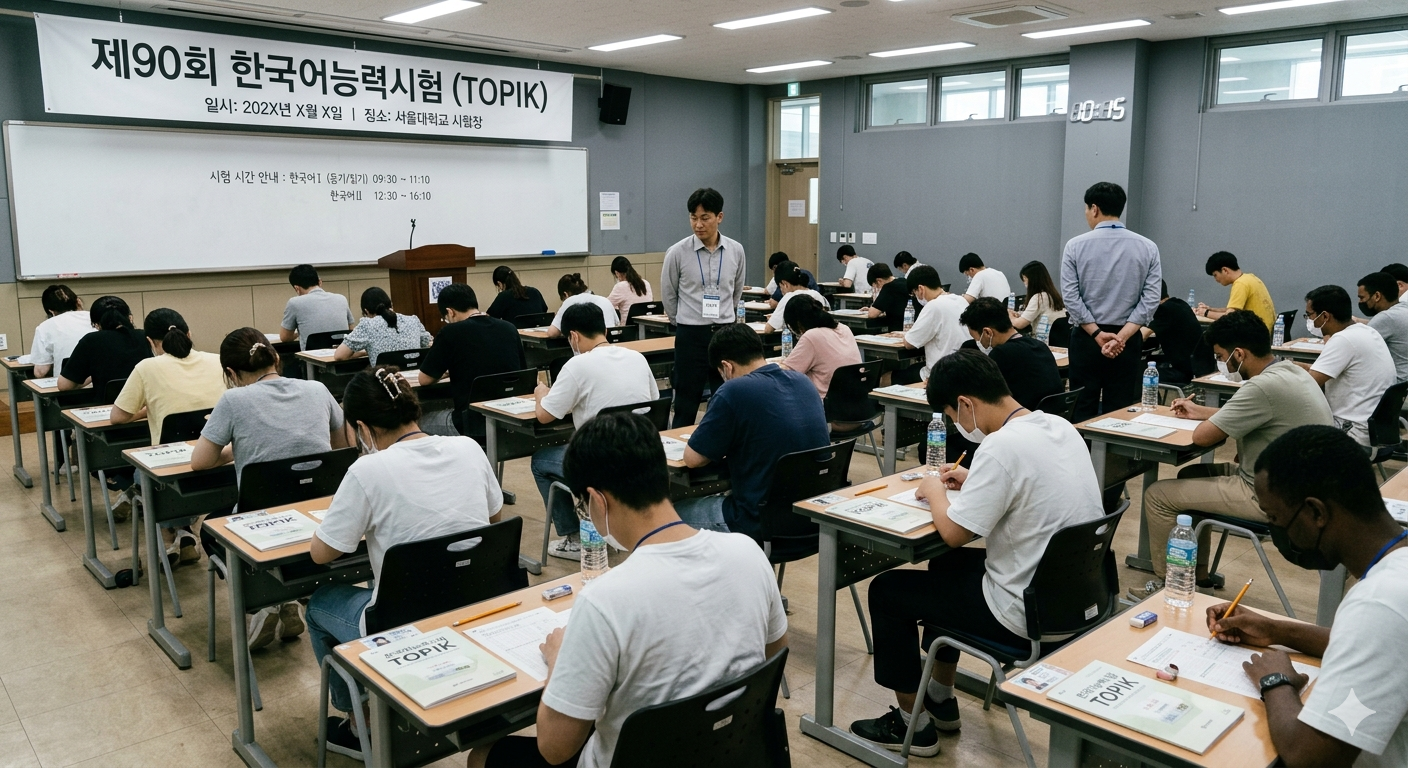
▪Korean language proficiency and year of study determine the allowed hours
Immigration applies differentiated weekly limits for part-time work based on TOPIK level (or KIIP stage) and previous semester grades. Undergraduate years 1–2 must meet TOPIK Level 3 (KIIP Stage 3), and undergraduate year 3 and above/graduate students must meet TOPIK Level 4 (KIIP Stage 4) to receive the standard limit (undergraduate 30 hrs/week, graduate 35 hrs/week, unlimited on weekends and vacations). Those who do not meet the requirement are limited to 10 hrs/week (graduate students 15 hrs/week) during both the semester and vacation. Transcripts are valid for 2 years from the date of issue.
3-(2)Allowed Hours by Level and Year
Allowed hours vary by Korean language proficiency and year of study. (General standard — subject to change)
| Category | Korean Language Requirement | Weekdays during semester | Weekends & Vacation |
|---|---|---|---|
| Undergraduate years 1–2 | TOPIK Level 3 / KIIP Stage 3 or above | 30 hrs/week | No limit |
| Undergraduate year 3 and above | TOPIK Level 4 / KIIP Stage 4 or above | 30 hrs/week | No limit |
| Graduate (Master's/Doctoral) | TOPIK Level 4 / KIIP Stage 4 or above | 35 hrs/week | No limit |
| Requirement not met (all categories) | Below required level/grade | 10 hrs/week (graduate students 15 hrs/week) | 10 hrs/week (graduate students 15 hrs/week) |
| ※ Common requirement: average grade C (2.0) or above in the previous semester. Language training (D-4) has separate standards, and some positions such as interpretation/translation require a higher Korean language level. Detailed standards may vary by school or local office. | |||
3-(3)TOPIK Recognition Criteria and Alternatives
- Score submitted at admission — The TOPIK level at the time of admission is used as the standard as-is. The school already has it on file without any separate report.
- Retaking the test while enrolled — If your level has gone up, you can submit the new transcript to the school's International Affairs Office and to immigration to request an increase in your weekly limit.
- TOPIK score validity = 2 years from date of issue — Scores submitted at admission also expire after 2 years. After expiry, you must retake the test or substitute with KIIP or an in-school Korean language test result.
- If you try to renew your part-time work permit with an expired TOPIK score, it may be treated as "Korean language proficiency unverified," and your limit could drop to the unmet threshold (10 hrs/week, or 15 hrs/week for graduate students).
Even without a TOPIK score or with a low score, if you are recognized for one of the following, you may apply close to the standard limit.
- Korean language training completion certificate — Completion certificate for Level 4 or above at a university-affiliated Korean language institute. Recognized as equivalent to TOPIK Level 4 at many universities.
- KIIP (Social Integration Program) completion — Operated by the Ministry of Justice. Passing the Stage 4 mid-term exam = recognized as equivalent to TOPIK Level 3; passing the Stage 5 final exam = recognized as equivalent to TOPIK Level 4.
- In-school Korean proficiency test — Some universities operate their own tests, and the results can be attached to the school recommendation letter and submitted to immigration.
- A school confirmation letter stating that you are regularly completing your major coursework in Korean can also be used as supplementary material.
3-(4)Frequently Asked Questions
4. Prior Permission Application Process
4-(1)Application Process at a Glance

▪School recommendation → Document preparation → Immigration application, 5 steps
Getting a part-time work permit is not a single one-step application but a process that moves through several stages. It starts with notifying your school's International Affairs Office, then gathering the required documents one by one — including your academic advisor's recommendation letter and your employment contract — and finally submitting them to HiKorea or the Immigration and Foreign Affairs Office. If even one document is missing, processing can be delayed, so it helps to check the full list in advance. Because the average processing time after applying is about 7–14 business days, it is safest to finish preparing your documents and submitting the application at least 3 weeks before your planned start date. The more lead time you allow, the better you can avoid being unable to work because the permit was delayed.
Pre-Application Self-Check Checklist
- Whether attendance rate for the previous semester is maintained at 70% or above
- Whether previous semester GPA is 2.0 or above (2.5 depending on school standards)
- Whether tuition payment and enrollment status are in good standing
- Whether you have a relationship where you can receive a recommendation letter from your academic advisor or department head
- Whether the employer's business registration industry category is not in the prohibited list
- Whether the employment contract clearly states hourly wage, days, hours, and job duties
- Whether the TOPIK transcript is within 2 years of the date of issue
Notify the School's International Affairs Office
First notify the school's International Affairs Office of your intention to work part-time and confirm the in-school procedures.
Obtain Academic Advisor Recommendation Letter
Obtain a recommendation letter from your academic advisor or department head confirming that your studies will not be adversely affected.
Prepare Employer and Employment Contract Information
Prepare an employment contract that clearly states the workplace information, working hours, job duties, and wages.
Apply via HiKorea or at the Immigration Office
Apply online at HiKorea (hikorea.go.kr) or in person at your local Immigration and Foreign Affairs Office.
Permit Issuance and Start of Work
Once the permit is issued, you may only work within the scope stated on the permit.
- Part-time work permit application form
- Copy of passport and alien registration card
- Proof of enrollment, grades, and attendance
- Academic advisor recommendation letter
- Copy of employer's business registration certificate
- Employment contract (hours, duties, wages)
- TOPIK transcript (if applicable)
4-(2)Application Document Checklist (9 items)
HiKorea form or the form available at the immigration office. Fill in all personal information and work details (address, hours, job duties).
Personal information page + visa page. If the remaining validity is less than 6 months, renewal is recommended first.
Both front and back. If lost, you must apply for a replacement first.
Within 1 month of the issue date. Available from the school's academic information system or self-service kiosk.
Previous semester GPA must be at or above a certain level (usually C/2.0 or above). May be waived for new students.
70% or above is the general standard. D-4 is assessed more strictly.
A recommendation letter in the name of the department head or academic advisor guaranteeing no adverse effect on studies. The school has a standard form.
Business registration certificate in the employer's (store's) name. Verify yourself that the industry category is not in a prohibited field.
Must include workplace location, days, hours, job duties, hourly wage, and payment date. Verbal agreements alone are not acceptable.
4-(3)Online (HiKorea e-Civil Service) vs. In-Person Application
Most schools recommend applying online. In-person is advantageous when corrections or immediate confirmation are needed.
| Category | HiKorea e-Civil Service | In-Person at Immigration and Foreign Affairs Office |
|---|---|---|
| Hours | 24 hours (excluding maintenance windows) | Weekday business hours (09:00–18:00) |
| Fee | Relatively lower for online applications | Based on in-person application rate |
| Processing Speed | Average 7–14 business days | Average 7–14 business days (wait time separate) |
| Document Correction | Online correction request → re-upload | Can be corrected on the spot |
| Advantages | No waiting or travel needed, real-time status tracking | Can consult directly with the officer in charge |
| Limitations | Requires account registration and joint certificate, file size limits | Appointment, queue number, and travel time required |
4-(4)Processing Time After Application
※ Applications tend to pile up right before new semesters (late February and August) and around the end/start of the year, causing further delays. Applying at least 3 weeks before your planned start date is recommended.
- Step 1 — Prior consultation: Notify the office of your intention to work part-time and receive the school's own guidelines and forms.
- Step 2 — In-school approval: The recommendation letter is circulated in the order: academic advisor → department head → International Affairs Office. Usually takes 3–5 days.
- Step 3 — Document package review: The International Affairs Office reviews the documents before submission to immigration. Any missing items can be caught in advance.
- Step 4 — Notification after application: Once the permit is issued, it is recommended to submit a copy to the school (for safekeeping against loss and for use at renewal).
- Change of workplace (job transfer) — Existing permit becomes void immediately. Must apply for a new part-time work permit from scratch based on the new workplace.
- Change of working hours/days — Even at the same workplace, a change application is required if the hours change. This is especially common at the semester-to-vacation transition.
- Change of job duties — A change application is required if duties change from simple assistance to a different role. If the change moves into a prohibited category, the permit itself will be revoked.
- End of employment — There is no mandatory reporting obligation, but it is safe to inform the school of the end date to have it on record for the next permit application.
- Leave of absence/work hiatus — Since taking a leave of absence removes the prerequisite condition (enrollment) for the permit, the permit becomes void. You must reapply after returning to school.
- Insufficient attendance — If the previous semester attendance is below 70%, the school recommendation itself will be refused.
- Business registration industry mismatch — There are many cases where the registration shows "adult entertainment" but the applicant thought it was a "restaurant" and the application is rejected.
- Missing items in employment contract — If even one of the hourly wage, days, or workplace address is missing, a correction is requested, extending the processing time accordingly.
- TOPIK transcript expired — A transcript older than 2 years from the issue date is not recognized, causing the limit to drop to the unmet threshold (10 hrs/week, or 15 hrs/week for graduate students).