Application schedule, documents, personal statement & interview — a step-by-step guide to getting accepted
1. Admission Schedule
1-(1)Admission Schedule at a Glance
▪March intake (spring semester) · September intake (fall semester) — twice a year
Korea's academic calendar runs on a two-semester system: a spring semester that begins in March and a fall semester that begins in September. This means there are two intake opportunities each year, so even if you miss one window, you can aim for the next one half a year later. Recruitment opens well before the semester starts — spring semester applications begin in September of the previous year, and fall semester applications begin in April of the same year. From there, the entire process — application deadline → interview → acceptance announcement → visa application — takes roughly 5–6 months, so it is safest to start preparing your documents and schedule early, based on the semester you are aiming for.
Spring Semester (March intake)
- Recruitment period: September–December of the previous year
- Largest number of recruiting schools
- Wide range of department choices
- New student orientation & tutoring designed around the spring semester
Fall Semester (September intake)
- Recruitment period: April–July
- Capacity is 30–50% of the spring semester
- Some popular departments do not recruit international students
- A natural fit for students graduating in June in their home country (Vietnam, China)
Korea's academic calendar runs on two semesters starting in March and September.
| Semester | Recruitment Period | Intake Date |
|---|---|---|
| Spring Semester (1st semester) | September – December of the previous year | March |
| Fall Semester (2nd semester) | April – July | September |
1-(2)Standard Admission Schedule by Semester
Spring Semester (March intake) Standard Schedule — 9 Steps
While it varies by school, most junior college international admissions follow this sequence. Spring semester activity begins in earnest from September of the previous year.
Admission Guidelines Published
Most junior colleges post their international admissions guidelines on the school's international affairs office website in July–August of the previous year. Eligibility requirements, capacity, required documents, and the schedule are all confirmed here.
July–August of the previous yearApplication Submission
The first round deadline is usually in September–November of the previous year. Schools typically hold separate first and second rounds, and some will not open a second round if capacity is filled in the first.
September–November of the previous yearDocument Review
The international affairs office reviews academic, financial, and Korean language documents. This usually takes 2–3 weeks after the application deadline. If anything is missing, you will receive a request to supplement.
November–December of the previous yearInterview (in-person or online)
Depending on the school, interviews may be conducted in Korean. Since COVID-19, many schools have shifted to online interviews, making it possible to participate from your home country.
November–December of the previous yearAcceptance Announcement
Results are announced mostly in December–January of the following year. Accepted applicants will separately receive a Standard Certificate of Admission (for visa application purposes).
December–JanuaryTuition Payment
After acceptance, you must usually pay one semester's tuition within 1–2 weeks. Failure to pay will result in cancellation of your acceptance and make it impossible to apply for a visa.
December–JanuaryD-2 Visa Application (at your home country's embassy)
Bring your Standard Certificate of Admission, tuition payment receipt, and proof of financial capacity to the Korean embassy in your home country to apply for a D-2 visa. Review usually takes 3–4 weeks.
January–FebruaryArrival in Korea (recommended 7–14 days before the semester starts)
After arriving in Korea, you should take care of administrative tasks in advance — moving into the dormitory, getting a SIM card, and opening a bank account — so your first week goes smoothly.
Mid-to-late FebruarySemester Starts + Alien Registration
Within 90 days of your arrival date, apply for your Alien Registration Card at the Immigration and Foreign Nationals Office. This overlaps with new student orientation and course registration, so make an appointment in advance.
Early MarchFall Semester (September intake) Standard Schedule — 9 Steps
The fall semester follows the spring semester schedule shifted by six months, but fewer schools participate and capacity is only 30–50% of the spring semester.
Admission Guidelines Published
Fall semester admission guidelines are usually posted in March of the same year. Many schools that already finished spring semester recruitment will additionally recruit international students.
MarchApplication Submission
Most applications are accepted from April to June. Some schools accept applications until early July.
April–JuneDocument Review
The process tends to move faster than the spring semester. With fewer international student spots, processing is quicker.
JuneInterview
Most interviews are conducted online. Fall semester schedules are tight, so it is difficult to reschedule the interview.
June–JulyAcceptance Announcement
Results are usually announced in mid-July. After acceptance, roughly 7–8 weeks remain until visa issuance.
JulyTuition Payment
Payment is due mostly by late July. Many schools have a shorter payment deadline than the spring semester.
Late JulyD-2 Visa Application
The embassy in your home country takes 3–4 weeks to process. Processing delays are common as this overlaps with holiday season back home, so applying late can be risky.
Late July–AugustArrival in Korea
Late August is the standard arrival time. Dormitory move-in and new student orientation are concentrated in the last week of August.
Late AugustSemester Starts + Alien Registration
Semester starts in early September. Alien registration must also be scheduled at the same time.
Early September1-(3)Schedule Management & Timing Guide
Examples of Schedule Variations by School
Some junior colleges (especially healthcare, nursing, and aviation programs) divide international admissions into rolling (previous year, September–October) and regular (previous year, December–January) rounds. Some schools prohibit applying in the regular round if you were accepted in the rolling round.
Popular departments (beauty, culinary, hotel) have a small international quota and often fill up entirely in the first round. Applications frequently close 1–2 weeks before the deadline, so treat the announcement date as the start of the application period and prepare accordingly.
Some junior colleges that did not fill capacity in the spring semester run a supplementary recruitment period for about one week starting around February 20. However, this is very risky for international students: after acceptance, it takes an average of 5–6 weeks to pay tuition → receive the Standard Certificate of Admission → apply for a D-2 visa, but supplementary recruitment takes place less than one month before the semester starts (early March). Supplementary recruitment for the fall semester is almost nonexistent.
Some schools recruit international students directly through their international affairs office rather than the general admissions office, and do not use common application systems such as Jinhakapply. Applications are accepted only through the school's own website form.
Average Time from Acceptance to Arrival in Korea
Monthly Calendar (Spring Semester Reference)
| Month | What the international student should do | School schedule |
|---|---|---|
| June–July of the previous year | Narrow down list of target schools, sit for TOPIK | Prepare draft admission guidelines |
| August of the previous year | Obtain academic documents, begin apostille/consular legalization | Finalize and publish admission guidelines |
| September–October of the previous year | Submit application (1st round) | Accept 1st round applications; begin document review |
| November of the previous year | Attend interview (online or in home country) | Conduct and evaluate interviews |
| December of the previous year | Check acceptance result, transfer tuition payment, receive Standard Certificate of Admission | Announce acceptance results; issue Standard Certificate of Admission |
| January | Apply for D-2 visa at Korean embassy in home country | Enrollment deadline; assist with visa process |
| February | Receive visa, enter Korea, move into dormitory | Prepare new student orientation |
| March | Semester starts; alien registration | Semester begins; course registration opens |
What to Do Right Now — A Time-Based Guide
Spring semester accepted students are in the visa and travel preparation phase; other students are waiting for fall semester or the following spring semester's admission guidelines. Right now, focus on sitting for the next TOPIK session and obtaining your academic documents. Vietnamese students need to factor in the consular legalization schedule (before 2026.09.11).
Fall semester recruitment is in full swing. If you're applying for the fall semester, focus on submitting your application and preparing for the interview. If you're applying for the following spring semester, spend your time narrowing your shortlist to 3–5 schools and sitting for additional TOPIK sessions.
Admission guidelines for the spring semester (March of the following year) are being released one by one in July–August. Compare each school's international student quota, required documents, and interview format, then make your final decision on which schools to apply to. Application submissions begin in September.
Spring semester application deadlines, interviews, and acceptance announcements all fall within this period. All documents must be in hand by D-14 before the deadline. After acceptance, prepare for tuition payment and D-2 visa application simultaneously.
On days close to the deadline, school admission systems and common application platforms like Jinhakapply experience heavy simultaneous traffic, causing frequent upload failures and payment errors. If you're making a payment transfer from Vietnam, Uzbekistan, or Mongolia, card limits and international card issues compound the problem, making it nearly impossible to resolve within 1–2 hours of the deadline. Remember that the deadline means the day the upload is completed, not the day you attempt it, and finish all submissions at least by D-3 before the deadline.
1-(4)Frequently asked questions
2. Required Documents Checklist
2-(1)Required Documents at a Glance

▪4 steps: "Obtain → Translate → Apostille/Consular Legalization → Submit to School"
Study-abroad documents are not a one-step process; they typically go through four stages: issuance → translation → apostille/consular legalization → submission to the school. First you obtain documents such as your diploma and transcript in your home country, then have them translated into Korean and notarized, and finally receive an apostille or a consular legalization stamp so that the documents are internationally recognized as authentic — only then can you submit them to the school. Each stage requires visits to different offices and its own processing time, so it takes longer than you might expect. To be safe, work backward from the deadline and plan so that every document is ready at least 2 weeks before it.
9 Basic Required Documents for International Student Admissions
- Application form (school format)
- Passport copy (personal information page)
- Proof of foreign nationality for applicant and parents (family register or certificate of nationality)
- High school graduation certificate (apostille or consular legalization)
- High school academic transcript (apostille or consular legalization)
- Proof of Korean language proficiency (TOPIK score or language course completion certificate)
- Proof of financial capacity (bank balance certificate, etc.)
- Passport-size photo
- Personal statement & study plan (school format)
2-(2)Document Issuance & Country-Specific Notes
Processing Time & Cost per Document
Documents go through 4 steps: "Obtain → Translate → Notarize/Apostille/Consular Legalization → Submit to School." If you don't calculate the cumulative time for each step in advance, it will be difficult to meet the deadline.
| Document | Issuing Authority | Processing Time | Estimated Cost (USD equivalent) |
|---|---|---|---|
| Application form | Download from school website | Immediately | Free (application fee separate: 50–100$) |
| Passport copy | Self-held | Immediately | Free |
| Family register / certificate of nationality | City hall / police bureau / ministry of interior in home country | 1–3 days | 5~20$ |
| High school graduation certificate | School of origin | 3–7 days | 5–30$ (+ apostille 30–70$) |
| High school academic transcript | School of origin | 3–7 days | 5–30$ (+ apostille 30–70$) |
| TOPIK score certificate | TOPIK National Institute for International Education | Available immediately after results are announced (PDF) | Free (exam fee approx. 40$) |
| Financial certificate (bank balance statement) | Bank in home country | 1–2 days | 5~30$ |
| Personal statement & study plan | Self-written | Preparation time: 1–2 weeks | Free |
| Passport-size photo | Photo studio in home country | Same day | 3~10$ |
Country-Specific Document Notes
Vietnam's Apostille Convention takes effect on September 11, 2026. Until then, the consular legalization process must still be used. The procedure is: ① 1st verification at the Consular Department of Vietnam's Ministry of Foreign Affairs → ② 2nd consular legalization at the Korean Embassy in Vietnam (Hanoi) or the Korean Consulate General (Ho Chi Minh City) → ③ certified Korean translation after arriving in Korea. The total process takes 2–4 weeks. Some schools may only recognize the consular legalization format even for documents issued after September, so check with the school before the deadline.
Uzbekistan is a member of the Apostille Convention. For academic documents, the procedure is: ① Obtain originals from the school of origin → ② Affix apostille at the Consular Department of Uzbekistan's Ministry of Foreign Affairs → ③ Translate Russian or Uzbek originals into Korean or English and have them notarized. Outside Tashkent, reaching the Ministry of Foreign Affairs can be difficult, adding 1–2 weeks. Note that some schools require documents to be re-certified by a Korean notary office after arriving in Korea.
Mongolia is also a member of the Apostille Convention, handled directly through the Consular Department of the Ministry of Foreign Affairs. However, high school graduation certificate formats vary by school in Mongolia, and some rural schools do not have an official English-language format, requiring additional documentation. Allow at least 2 weeks of buffer time to be safe. Some schools also require an auxiliary verification procedure at the Korean Embassy (Ulaanbaatar).
China's Apostille Convention took effect on November 7, 2023, eliminating the consular legalization procedure. The process is: ① Obtain graduation and academic certificates from the high school of origin → ② Affix apostille at China's Ministry of Foreign Affairs or a regional Foreign Affairs Office (外事办公室) → ③ Translate into Korean or English with notarization. Processing speed at Foreign Affairs Offices varies significantly by region: within 1 week in Beijing and Shanghai, 2–3 weeks in other provinces.
2-(3)Notarized Translation & Submission Methods
Certified Translation Guide
- Translation language: Most junior colleges only accept translations in Korean. Many schools only take English translations as supplementary materials.
- Translate in home country: Translate first into English in your home country + notarize in home country → re-translate into Korean in Korea + notarize at a Korean notary office (safest option).
- Translate in Korea: Bring the original documents from your home country directly to a certified translation office in Korea for Korean-language certified translation (approximately 30,000–50,000 KRW per document in Seoul).
- School-designated: Some schools operate their own translation centers and do not accept external notarizations. If the admission guidelines contain the phrase "school-designated format," be sure to contact the school directly.
Translation costs approximately 10,000–20,000 KRW per page, and notarization is approximately 20,000 KRW per document. Processing graduation and transcript (2 documents) together can be completed for a total of 50,000–100,000 KRW.
Comparison of Document Submission Methods
| Method | Advantages | Disadvantages | School adoption rate (reference) |
|---|---|---|---|
| Mail (EMS / DHL) | Originals accepted; can be submitted directly to Korean notary office | International mail takes 7–14 days; risk of loss | Approx. 40% |
| Email (PDF scan) | Instant delivery; no additional cost | Many schools still require original documents to be mailed separately | Approx. 30% |
| Online system (school website / Jinhakapply) | Immediate confirmation upon submission; payment and tracking available | File size/extension restrictions; upload failures when server is overloaded | Approx. 25% |
| Agent (family or acquaintance living in Korea) | Can submit in person at the school; can respond immediately to supplement requests | Agent's ID and power of attorney required; unofficial study agents are risky | Approx. 5% |
When documents are missing, schools usually send supplement requests by email only. If the email from your home country goes to spam, or if the student rarely checks email and only uses a home-country phone number, the application ends up incomplete → automatically rejected. Even after submitting your application, check your email and school portal at least once a day, and if possible, call the school's international affairs office directly to confirm that your application is complete.
2-(4)Frequently asked questions
3. Personal Statement & Study Plan Writing Guide
3-(1)Personal Statement & Study Plan at a Glance
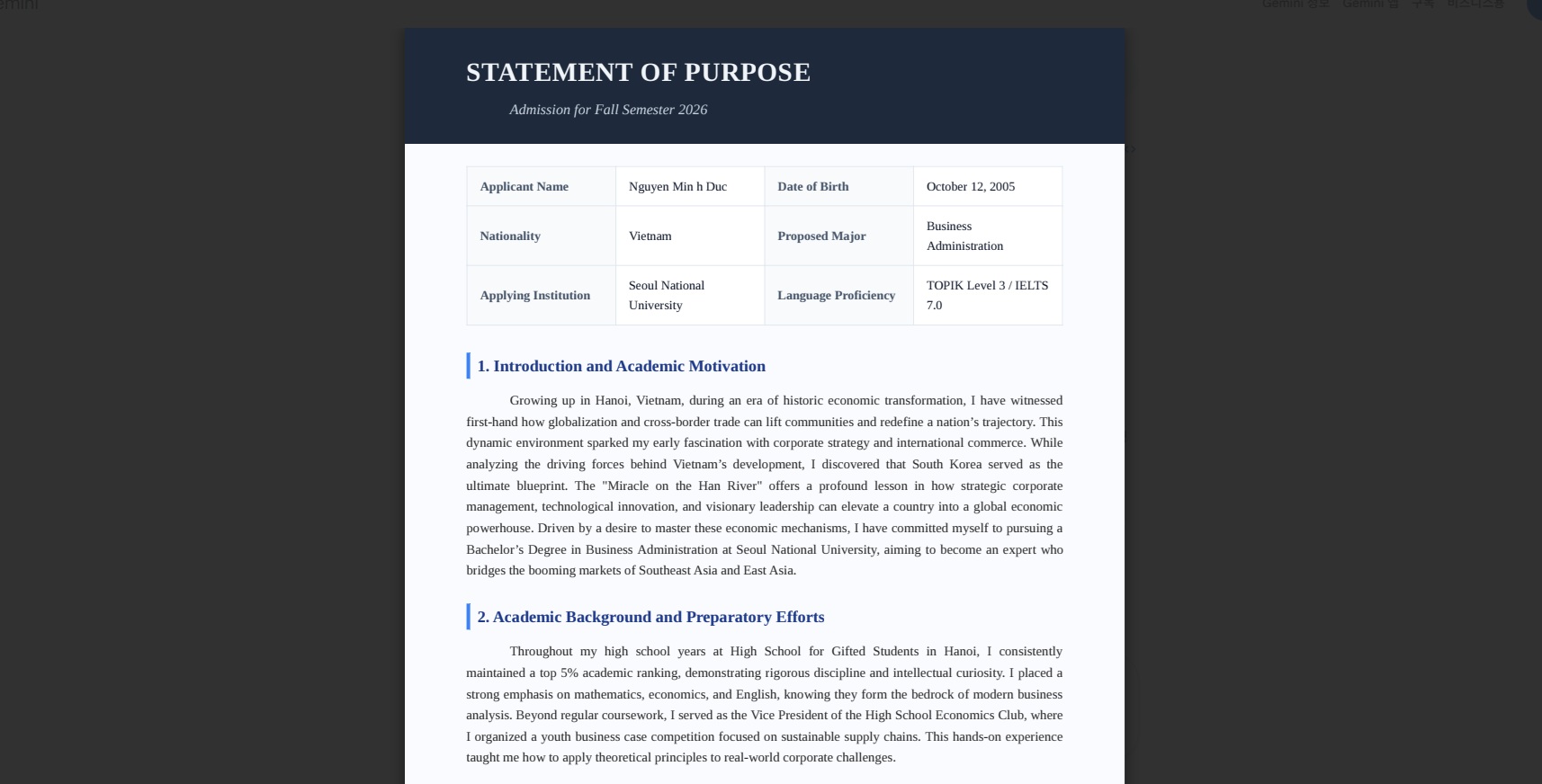
▪Personal statement: writing about "the past me"; study plan: writing about "the future me"
The personal statement and the study plan look similar, but they look at different points in time. The personal statement is about the "past you" — your background, your reasons for applying, and your strengths — while the study plan is about the "future you" — your academic plans after enrollment and your career goals after graduation. Both are key documents that determine acceptance in the international special admissions process, and reviewers read them to gauge both your sincerity and your command of Korean. In particular, plagiarizing someone else's writing or submitting awkward sentences pasted straight from a translation tool is grounds for automatic disqualification, so even if it takes time, the most important thing is to write your own story honestly and naturally, in your own words.
International special admissions are evaluated primarily on documents and interviews. The personal statement and study plan are the key documents that determine acceptance. The two documents look similar but have different purposes and content.
Personal Statement vs. Study Plan
| Category | Personal Statement | Study Plan |
|---|---|---|
| Purpose | "Who I am" — personality, motivation, background | "What I will do in Korea" — academic and career plans |
| Length | Typically 1–2 pages (A4) based on the school's form | Typically 1–2 pages (A4) based on the school's form |
| Key Content | Background, family, motivation, strengths | Academic plan after enrollment and career path after graduation |
| Timeframe | Past → Present (who I have been) | Present → Future (who I will become) |
| Key Verbs | I did~ · I experienced~ | I will do~ · I plan to~ |
3-(2)Structure of the Two Documents
5 Steps for Writing a Personal Statement
- Briefly describe your family, hometown, and school years
- 1–2 events that shaped your values
- Approximately 15–20% of total length
- Clearly explain why Korea, not the US, Japan, or Australia
- K-content alone is not enough; include Korea-related experiences from your home country
- A family member or acquaintance who has lived in Korea is also good material
- Specific interests and experiences related to the major
- Connect to high school clubs, part-time jobs, or certifications
- "Good job prospects" alone is too weak
- Connect to the competencies required by the major
- Use concrete examples rather than abstract words like "diligence" or "responsibility"
- Korean language learning efforts can also be included as a strength
- Clearly state your position: return to your home country vs. find employment in Korea after graduation
- A direction that benefits both your home country and Korea is recommended
- Keep the tone consistent with your academic plan
5 Steps for Writing an Academic Plan
- Improve Korean proficiency (e.g., TOPIK Level 3 → Level 4)
- Complete foundational major courses, target GPA
- Adjust to life in Korea, participate in school clubs
- Advanced major courses, practicum, internship, certifications
- Specify national technical qualifications and on-site industry training
- For 3-year programs, include clinical or practicum timing as well
- Target GPA, certifications to earn, internship experience
- Choose between transferring (4-year university) or finding employment
- Clearly state direction: returning home or advancing in Korea
- Specify concrete job role, industry, and location
- Rather than "get a job at a large Korean company," say "[specific role] in [specific field]"
- Explain how you will use your skills when returning to your home country
- Subjects, professors, and research fields you are interested in
- Check and cite actually offered courses on the school's website
- This signals that you have done your homework on the school
3-(3)Winning Writing Strategies
5 Tips for Writing a Winning Personal Statement
Instead of "I worked hard," write things like "Won ○○ award at ○○ competition" or "Wrote down dialogue from 5 Korean dramas every day for ○○ months" — use numbers, time, and results.
Do not fabricate things that never happened. Even an ordinary true story is far more convincing than a made-up one. The same questions will come up in the interview.
Attending Sejong Institute classes, working part-time at a Korean company, having Korean friends, or hosting a Korean exchange student in your home country — even small experiences show your "connection to Korea."
Every episode in your personal statement should ultimately flow toward "that's why this major." If you're applying to cosmetology but only talk about IT, it will count against you.
If your Korean is still lacking, honestly admit it and present a plan for how you will improve after enrollment. Acknowledging a weakness and offering a solution is evaluated more positively than hiding it.
5 Common Mistakes
- Generic opener — Sentences like "Ever since I was young, watching Korean dramas, I grew to love Korea" are read by reviewers dozens of times a day. Find your own unique opening sentence.
- Exaggeration or fabrication — Fake awards, inflated Korean proficiency. If caught during interview or document verification, it becomes grounds for admission cancellation.
- Copy-pasting from the internet — Using sample statements from agencies or the web verbatim will be caught by plagiarism checks and similarity reviews.
- Translated phrasing — Korean that is directly translated from your native language word-for-word. Unnatural expressions like "regarding~" or "efforts for doing~" accumulated throughout reduce readability.
- Spelling and spacing errors — Even if Korean is not your first language, frequent basic errors with particles like 은/는 or 이/가 will result in deductions in the diligence evaluation.
Writing in Korean vs. English — School-by-School Requirements
| Category | Written in Korean | Written in English |
|---|---|---|
| Schools that require it | Most junior college international student admissions (standard) | Some schools' "international tracks" or English-medium departments |
| Required Korean proficiency | TOPIK Level 2–3 or above recommended | English submission allowed even with insufficient Korean |
| Advantage | Can directly demonstrate Korean language ability | Your intention is conveyed accurately |
| Disadvantage | Risk of unnatural phrasing and spelling errors | May raise doubts about your willingness to complete Korean-language coursework |
| Recommendation | Write the main text in Korean + have a Korean native proofread only the awkward parts | Your Korean study plan must be included in the main text |
Personal Statement Opening Sentence — Good Examples vs. Bad Examples
- "I have loved Korean dramas since I was young."
- "Hello. My name is ○○○."
- "Korea is a highly developed country."
- → The most common openings reviewers read; they leave no impression
- "While working as a cleaner three times a week at a Korean beauty salon in Hanoi, I first discovered the profession of 'skin care.'"
- "The day I visited a Korean auto repair factory in Tashkent, I changed my career path."
- → A specific scene unique to you + connected to your major
Reviewers read hundreds of identical personal statements. You need a story that is uniquely yours.
3-(4)Frequently asked questions
4. Interview Preparation
4-(1)Interview Preparation at a Glance

▪The final hurdle to acceptance — they assess your Korean communication skills and genuine interest in the major
The interview is the final gateway to acceptance — a chance to verify in person who the "applicant" seen only on paper really is. Two things sit at the heart of the evaluation: your Korean communication skills, enough to handle classes and daily life without trouble, and your genuine motivation and sincerity in applying to that particular department. Depending on the school, interviews are conducted in four formats — in-person, online (Zoom), phone, or recorded video — so preparing your answers to likely questions in Korean ahead of time and practicing speaking clearly will help you face any format with far more confidence.
Prepare answers to expected questions
Write answers in Korean for 10 common questions + 5 personal statement-based questions
Korean native proofreading
Request feedback on your answers from a Sejong Institute, Korean Education Center, or Korean friend
Mock interview recording
Record your answers on a smartphone and review them; check facial expression, eye contact, and speaking pace
Technical and environment check
Test Zoom, check internet speed, lighting, and camera angle
Organize documents and rest
Place your passport and a copy of your personal statement on the desk; get enough sleep
The interview is the final hurdle for international student admissions. It is a chance to verify who the "applicant" seen on paper really is, and to assess whether they can communicate in Korean and whether they have genuine interest in the major.
4 Types of Interviews
| Type | Method | Preparation Points | Junior College Frequency |
|---|---|---|---|
| In-person interview | Visit your home country or the Korean campus | Non-verbal cues like attire, greetings, and facial expressions are important | Mainly for foreigners already residing in Korea |
| Online (Zoom) | Live video call | Internet connection, lighting, background, camera angle | Most common |
| Phone interview | Voice only | Pronunciation, speaking pace, avoid one-word answers | Supplementary method at some schools |
| Recorded video | Receive question sheet and submit a video | Re-recording allowed, editing prohibited | Used for initial screening |
4-(2)Common Questions & Answer Strategies
10 Common Interview Questions
"Why did you apply to our school?" — You must mention at least one specific feature of the school (major, practicum, dormitory, etc.).
"How did you study Korean?" — In addition to your TOPIK level, it is good to answer with your study method and duration.
"Why this major?" — Your answer must be consistent with what you wrote in your personal statement, and you should be more specific.
"What will you do after graduation?" — Return to your home country or stay in Korea; give a clear answer for one of the two.
"What are your strengths and weaknesses?" — It is safer to rephrase a weakness as "something I am currently working on improving."
"What comes to mind when you think of Korea?" — Don't just talk about K-content; answer with your own Korea-related experiences.
"How will you cover tuition and living expenses?" — Answer specifically: family support, personal savings, scholarships, and part-time work.
"How does your family feel about studying abroad?" — "The whole family is supportive" is the standard answer; bonus points if your family has a connection to Korea.
"What do you do on weekends?" — Prepare 1–2 hobbies or self-development activities related to your major in advance.
An everyday Korean question like "What did you have for breakfast this morning?" — a question to check your "real" Korean ability. Answer briefly and naturally.
Interview Answer Writing Guide
- Situation
- Task (Role / Assignment)
- Action
- Result
- Effective for experience-based questions
- Keep each answer within 30–60 seconds
- The weaker your Korean, the shorter your sentences should be
- "Bottom line first" — lead with the conclusion
- Longer answers increase the risk of Korean language mistakes
- The interviewer has your personal statement in hand
- Answers that differ from the document immediately raise suspicion
- Elaborate on the document content in "more detail"
- Add only one or two new stories
4-(3)Dress Code, Etiquette & Prep Schedule
Interview Attire & Etiquette
- Men: shirt and slacks (black or navy); no jeans or short sleeves
- Women: blouse or shirt with neat bottoms; avoid excessive exposure
- Even for online interviews, dress neatly from head to toe (you might need to stand up suddenly)
- Choose a top that contrasts with the background
- Greet politely when entering and leaving: "안녕하세요. 잘 부탁드립니다"
- Use formal speech 100% of the time (informal speech is never allowed)
- Address interviewers as "교수님" (Professor)
- For questions you don't know: "죄송합니다, 잘 모르겠습니다" is the right answer
- Camera at eye level, face centered on screen
- Lighting from the front; avoid backlighting
- Background: clean wall or solid-color background
- Test earphones and microphone in advance
- Wired internet or stable WiFi
- Laptop or PC recommended (smartphone is for emergencies only)
- Log into Zoom and wait 30 minutes before the interview
- Keep your passport and a copy of your personal statement nearby
Interview D-7 Preparation Schedule
Write a list of expected questions
Write answers in Korean for the 10 common questions above + 5 personal statement-based questions.
Korean native proofreading + pronunciation correction
Ask a Sejong Institute teacher, Korean Education Center, or Korean friend to review your answers. Mark difficult-to-pronounce words.
Mock interview (video recording)
Record your answers on a smartphone and review the footage. Check facial expression, eye contact, and speaking pace.
Technical and environment check
Test Zoom, check internet speed, lighting, and camera angle. Prepare a smartphone hotspot as backup.
Rest well and organize documents
Place your passport, personal statement, and school form copies on the desk. Be ready and waiting 10 minutes before the interview.
4-(4)Interview Language & Common Mistakes
Korean-language Interview vs. English-language Interview
| Category | Korean-language interview | English-language interview |
|---|---|---|
| Target | General international student track (most cases) | International track or English-medium departments |
| Required level | TOPIK Level 3 or above recommended | Sufficient to express yourself |
| Interview length | 10–20 minutes | 15–25 minutes |
| Notes | Formal speech, clear pronunciation, speak slowly and clearly | Must show willingness to learn Korean |
| Use some Korean | Not applicable | Recommended to attempt greetings and self-introduction in Korean |
5 Common Mistakes During the Interview
- Unnecessary honesty — Answers like "I wasn't actually interested in Korea, but my parents told me to go" or "I'll go back home once I earn enough money" are instant deductions. There is a difference between honesty and "blurting things out without strategy."
- Overconfidence — "My Korean is perfect" or "I'm confident I can be top of the class" will prompt the interviewer to verify with harder questions right away. A humble "I will work hard" is safer.
- Off-topic answers — If you didn't understand the question, don't guess and answer. "죄송합니다, 다시 한 번 말씀해 주시겠어요?" (Excuse me, could you say that again?) is the right answer.
- Interrupting the interviewer — Cutting in while the interviewer is speaking is very negative. Listen until the end and wait 1–2 seconds before answering.
- No expression, no smile — A blank face from nervousness is interpreted as "lacking enthusiasm." Even slightly turning up the corners of your mouth changes the impression.
Interviewers value a sincere attitude and genuine passion for the major more than perfect Korean.